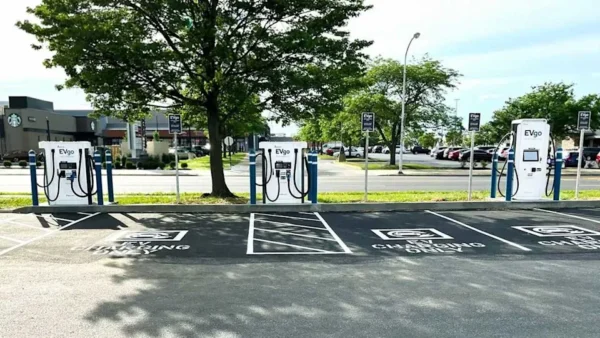
EVgo’s plan to install at least 150 DC fast-charging stalls per year through 2035 at locations operated by the Kroger Family of Stores marks more than a routine infrastructure expansion. It reflects a broader shift in how electric vehicle (EV) charging is being integrated into everyday life for American consumers.
Rather than focusing solely on highways or dedicated charging hubs, EVgo is betting on a simpler idea: people are far more likely to charge when it fits naturally into what they already do.
From pilot project to long-term strategy
The EVgo–Kroger partnership began in 2022, but the new agreement significantly raises the stakes. Select Kroger locations will now be equipped with up to 16 DC fast-charging stalls per site, creating mini charging hubs embedded within neighborhood retail centers.
The first location under this expanded rollout is already live in Salt Lake City, Utah, with additional sites planned across Arizona, California, Florida, Georgia, Texas, Washington, and other states. Importantly, chargers will be installed across multiple Kroger-owned banners—Kroger, Foods Co., Fred Meyer, Fry’s Food Stores, Harris Teeter, King Soopers, and Smith’s Food and Drug—ensuring both urban and suburban reach.
Why grocery stores make sense for EV charging
For many U.S. consumers, the main obstacle to EV adoption is no longer the upfront cost of the vehicle. It is charging access and convenience, especially for drivers who:
-
Live in apartments or rental housing without home chargers
-
Depend on their vehicle for daily errands
-
Have limited time for dedicated charging stops
Grocery shopping typically takes 30 to 60 minutes, which aligns well with DC fast charging for a meaningful battery top-up. By placing chargers at supermarkets, EVgo reduces the psychological and practical friction associated with EV ownership. Charging becomes a background activity, not a separate task.
This model also supports a key reality of American life: weekly grocery trips are nearly universal, regardless of income level or region.
Executive perspective and strategic intent
EVgo CEO Badar Khan has framed the expansion as a move toward providing EV drivers with “the convenience of charging where they shop.” Strategically, this positions EVgo not just as a charging provider, but as a daily-life infrastructure partner.
For Kroger, the benefit is equally clear. Charging stations increase dwell time, attract higher-income EV-driving customers, and future-proof store locations as transportation trends evolve.
Practical tips for EV drivers
As this network grows, EV owners can extract real value from supermarket-based charging by following a few practical guidelines:
-
Pair charging with routine errands: Use grocery trips for regular top-ups instead of waiting for low battery levels.
-
Use real-time availability tools: Check EVgo’s app before arriving to avoid queues during peak hours.
-
Charge strategically, not fully: Fast-charge to around 80% while shopping to save time and protect battery health.
-
Think local, not long-distance: These locations are ideal for neighborhood charging, not long road-trip stops.
Final outlook: a quiet but powerful shift
The EVgo–Kroger expansion illustrates a subtle but important evolution in the U.S. EV ecosystem. Charging infrastructure is moving away from being destination-based and toward being habit-based.
If executed consistently through 2035, this approach could significantly reduce range anxiety for everyday drivers and lower one of the final psychological barriers to EV adoption. More importantly, it signals that the future of EV charging in the U.S. will be defined not just by speed or scale, but by how seamlessly it fits into ordinary life.