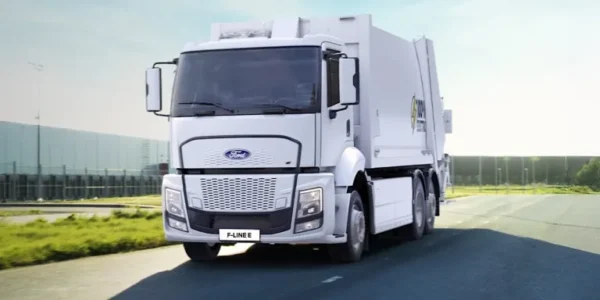
Ford is stepping more decisively into the medium- and heavy-duty EV space with the new F-Line E, an electric semi truck designed less for hype and more for the kind of work trucks actually do every day. Set to roll onto Western European roads in 4×2 and 6×2 configurations, the F-Line E is aimed squarely at regional distribution, urban logistics, and municipal fleets—jobs where predictability matters more than bragging rights.
Built at Ford’s truck plant in Turkey, the F-Line E uses a modular battery approach that reflects that practical mindset. Operators can spec up to four 98 kWh nickel manganese cobalt (NMC) battery packs, delivering a total capacity of 392 kWh. Supplied by German Tier 1 partner ZF, the system provides enough energy for up to 300 km (about 185 miles) of range in the heaviest 6×2, 26-ton configuration. That figure may not sound dramatic compared to long-haul concepts, but it’s well matched to regional routes where trucks return to base daily.
Power is delivered through a ZF-developed electric axle producing 390 kW (around 525 hp) and a staggering 2,470 Nm (1,820 lb-ft) of torque. That kind of low-end grunt is exactly what matters when pulling away from loading docks, stop-starting through city traffic, or hauling heavy refuse bodies. It’s a reminder that torque, not top speed, is the real currency of working trucks.
Charging capability reinforces the F-Line E’s operational focus. The 6×2 version supports DC fast charging at up to 285 kW, while the lighter 4×2 variant exceeds 200 kW. In both cases, the batteries can be replenished from 20% to 80% in roughly 45 minutes—conveniently similar to the time it takes to unload and reload at a regional depot. For fleet managers, that alignment between charging and workflow is far more valuable than extreme peak charging numbers.
Ford has also paid attention to vocational flexibility. The F-Line E supports electric power take-off (e-PTO) systems, enabling zero-emission operation of auxiliary equipment such as refuse compactors or municipal machinery. Rear air suspension and an electric air compressor come standard, and refuse bodies are already in development. Trailer towing ratings of up to 10 tonnes further broaden its appeal for mixed-duty operations.
According to Ford Trucks, production is already under way, with the first European deliveries expected in summer 2026. The F-Line E may not redefine what an electric truck can do on paper, but it does something arguably more important: it fits into the rhythms of real-world logistics. In a segment still searching for practicality, that may be exactly what fleet operators are waiting for.