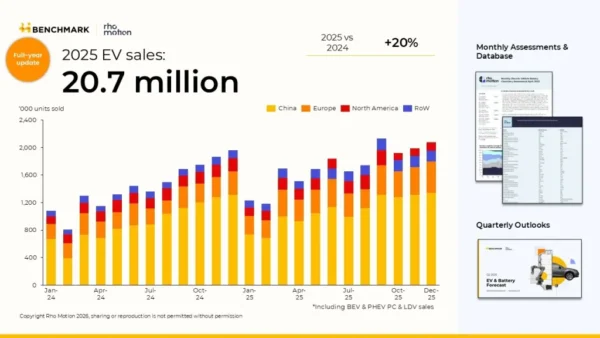
Global electric vehicle sales reached an estimated 20.7 million units in 2025, according to new data from Rho Motion. That figure represents an increase of 3.6 million EVs compared with 2024—slightly higher than the previous year’s growth and continuing a multi-year upward trend. On the surface, the numbers contradict a narrative that has dominated headlines for much of the past two years: that EV demand is faltering.
If public perception were shaped only by media coverage and political debate, 2025 might have looked like a turning point in the wrong direction. Stories about “cooling demand,” automakers scaling back EV plans, and governments reconsidering incentives were widespread. In some cases, manufacturers themselves reinforced this message by delaying model launches or shifting investment toward hybrids and extended-range vehicles.
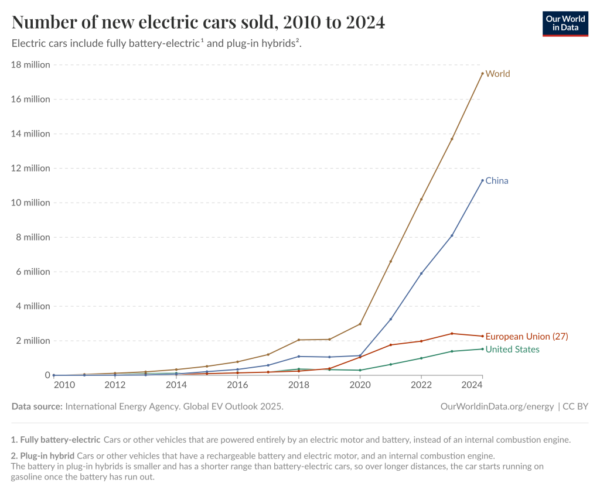
Yet the aggregate sales data tells a different story. Global EV volumes didn’t stagnate or shrink—they accelerated. That raises a more nuanced question: why are EV sales still growing?
Price Pressure and Product Maturity
One clear driver is pricing. In many markets, EV prices continued to fall in 2025, either through direct price cuts, cheaper battery chemistries such as LFP, or the arrival of more affordable models from Chinese and legacy automakers alike. For many buyers, EVs crossed an important threshold from “premium technology” to “financially comparable” with internal combustion vehicles.
At the same time, the EV market is no longer experimental. Models launched in the last two to three years are benefiting from improved reliability, better software, and more predictable ownership costs. This maturity reduces risk for mainstream buyers who may have been hesitant earlier in the transition.
Infrastructure and Everyday Usability
Charging infrastructure also continued to expand, unevenly but meaningfully. In regions where public charging density improved—particularly parts of Europe and China—EV ownership became less about idealism and more about convenience. Even in markets where charging remains inconsistent, home charging and longer-range vehicles reduced daily friction enough to tip purchase decisions.
Curiosity, Compliance, or Genuine Demand?
Not all growth necessarily reflects deep consumer conviction. In some markets, EV adoption is still driven by regulation, fleet mandates, or incentives rather than pure preference. In others, curiosity plays a role: buyers testing EV ownership now that costs and risks feel lower.
However, the persistence of growth—even amid political resistance, reduced subsidies, and negative messaging—suggests demand is not purely artificial. If sales were driven only by incentives or novelty, growth would likely have flattened once those supports weakened. Instead, volumes increased again.
Perspective
The EV market in 2025 does not look like one that is collapsing—but neither does it look like a frictionless revolution. Growth appears to be coming from a combination of lower prices, broader model availability, and gradual normalization of EV ownership rather than hype or idealism.
Whether this momentum continues will depend on how manufacturers balance affordability, infrastructure investment, and long-term policy stability. For now, the data suggests that EV adoption is being pulled forward less by curiosity and more by practicality—but the next phase will test how resilient that demand really is once the transition loses its novelty entirely.