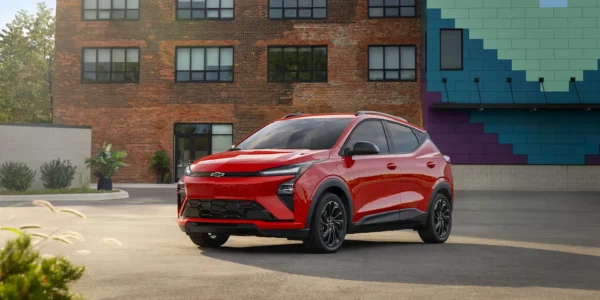
General Motors has only just restarted production of the new Chevy Bolt EV at its Fairfax Assembly plant in Kansas, but the clock is already ticking. The updated Bolt, which entered production in November, is not expected to stay there for long. Once Bolt production ends, GM plans to convert the facility to build only internal combustion engine (ICE) vehicles—a decision that underlines how uncertain the path forward remains for affordable electric cars in the US.
When GM unveiled the redesigned 2027 Chevy Bolt EV last October, it framed the model as a comeback and a signal that affordable EVs still mattered. Starting under $30,000, the Bolt was meant to reinforce Chevrolet’s position as a leader in mass-market electrification. GM even hinted that the new Bolt would be the first in a broader family of low-cost EVs.
Less than a year later, that vision looks far less certain.
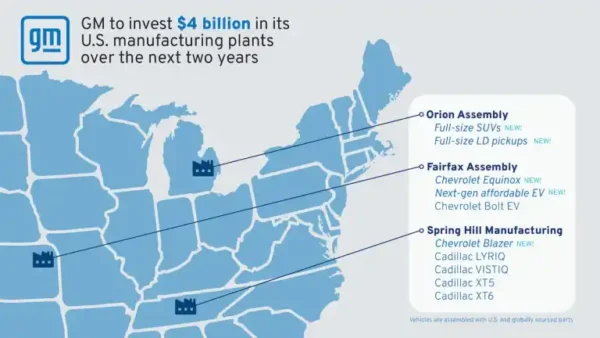
GM confirmed this week that production of the Buick Envision, currently built in China, will shift to the Kansas plant starting in 2028. The move follows higher US tariffs on Chinese-built vehicles and is framed by GM as a way to strengthen domestic manufacturing and protect American jobs. From an industrial policy standpoint, the decision makes sense. From an EV strategy standpoint, it raises uncomfortable questions.
Although the Bolt EV is now being built in Kansas using LFP batteries sourced from China’s CATL, the Fairfax plant is already slated to transition to gas-powered vehicles. The Chevrolet Equinox (ICE) is expected to join the lineup in 2027, and with the Envision arriving in 2028, Bolt production could end after roughly a year and a half. For consumers, that means the window to buy one of the most affordable EVs on the US market may close quickly.
This matters because the Bolt fills a gap that few automakers are addressing. While EV sales in the US continue to grow, most new models skew toward higher price points. Outside of Tesla, GM sold more EVs in the US last year than any other automaker, largely thanks to the Equinox EV and Cadillac’s expanding luxury range. The Bolt, however, was different: small, simple, and priced for buyers who want an EV without stretching their budget.
For those buyers, GM’s shifting plans create uncertainty. Short production runs can affect resale values, long-term support, and consumer confidence. If the Bolt becomes another limited-run EV rather than a stable, long-term product, it risks reinforcing the perception that affordable EVs are still an experiment rather than a commitment.
There is also an environmental dimension to the decision. EVs like the Bolt play an outsized role in reducing emissions because they are accessible to a broader audience. Replacing EV production with ICE vehicles may protect jobs in the short term, but it complicates GM’s longer-term climate goals—especially after the company recently acknowledged a roughly $6 billion financial hit tied to scaling back parts of its EV strategy.
GM has said little about what comes next for the Bolt platform, or whether the promised “next-gen affordable” EV will still materialize in Kansas. For now, those plans remain vague, leaving consumers and environmental advocates alike waiting for clarity.
The Bolt’s brief return is a reminder that the EV transition is not just about technology, but about consistency and trust. Building affordable electric cars for only a short window sends mixed signals to buyers who are being asked to change how they drive, charge, and think about transportation.
The broader question is whether GM sees affordable EVs as a cornerstone of its future, or as a stopgap while market conditions evolve. Until that answer becomes clearer, the Bolt EV risks becoming a symbol not of progress, but of how fragile the promise of mass-market electrification still is.