
Honda has taken an unexpected step into the outdoor lifestyle space with the Base Station Prototype, a compact travel trailer designed to be light, flexible, and accessible—even for EV owners. Revealed this week, the concept reflects Honda’s attempt to rethink what “going camping” looks like for a broader, more urban audience.
A trailer designed for everyday vehicles
Honda describes the Base Station as an “entirely new towable travel trailer,” with one key goal: make outdoor travel less intimidating. Unlike traditional RVs or large campers, this prototype is intended to be towed by mainstream crossovers such as the CR-V and Toyota RAV4, as well as electric vehicles like the Prologue and Honda’s upcoming 0 Series EVs.
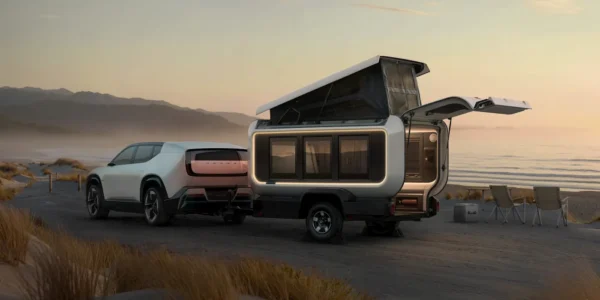
That positioning matters. Towing capacity is often a barrier for first-time campers, especially EV owners concerned about range loss. By keeping the trailer lightweight and compact enough to fit in a standard garage or parking space, Honda is clearly targeting casual users rather than hardcore overlanders.
Practical comfort, not rugged adventure
Inside, the Base Station leans more toward comfort and usability than extreme adventure. Honda says the cabin is open and airy, with five large removable side windows and a layout that can extend to provide around seven feet of standing height. The rear tailgate doubles as a covered outdoor area, blurring the line between interior and exterior living.
The interior setup suggests weekend trips rather than long expeditions. Sleeping space is designed for a family of four, with a fold-out queen-size bed and optional bunk. Features such as air conditioning, an outdoor shower, and an exterior kitchen with running water reinforce the idea of “easy camping” rather than minimalist travel.
EV-friendly, but not EV-exclusive
One of the more interesting aspects is the trailer’s off-grid capability. A built-in lithium-ion battery, inverter, and integrated solar panels allow for zero-emissions power when parked—useful for quiet campsites or short off-grid stays. However, this doesn’t turn the Base Station into a full remote exploration tool. Instead, it supports short-duration independence, aligning with its lightweight, accessible philosophy.
Is this really a travel trailer?
That’s the central question. The Base Station looks less like a traditional travel trailer and more like a bridge between car camping and RV life. It’s not designed to replace motorhomes or serious expedition rigs. Rather, it lowers the entry barrier for families or individuals curious about camping but unwilling to invest in large vehicles, specialized towing setups, or complex gear.
Price will ultimately define its success. Honda has suggested a target range between $20,000 and $40,000, placing it squarely in the middle of the lightweight trailer segment. At the lower end, it could appeal strongly to new campers. At the higher end, buyers may begin comparing it to more established options with greater long-term versatility.
Perspective
The Honda Base Station doesn’t try to reinvent travel—it reframes it. Instead of asking people to adapt to camping culture, Honda adapts camping to modern, everyday lifestyles. Whether that makes it a “true” travel trailer or a lifestyle accessory depends on expectations. For casual travelers and EV owners seeking simplicity, it could be exactly enough. For seasoned campers, it may feel like a comfortable starting point—but not the final destination.