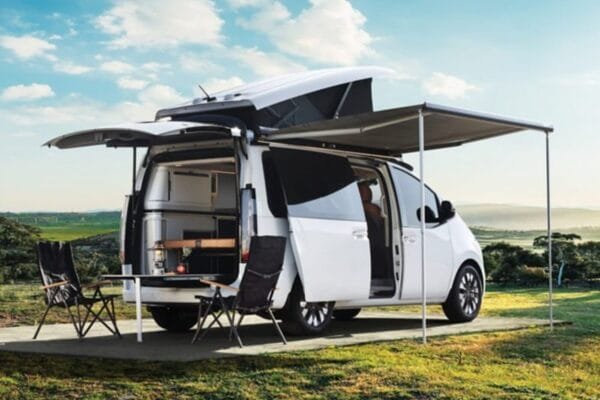
Hyundai has revealed an all-electric camper van concept designed for off-grid adventures, blending zero-emissions driving with features traditionally reserved for high-end motorhomes. Just over a week after debuting the Staria Electric, Hyundai showcased the Staria Electric Camper Concept at the CMT Stuttgart, positioning it as a premium, tech-forward take on electric van life.
Electric foundations built for long trips
The camper is based on the same platform as the Staria Electric MPV and offers an estimated WLTP range of up to 400 km (249 miles). For an electric MPV of this size, that figure places it near the top of its segment—particularly important for travelers who may be far from charging infrastructure.
Underneath, the camper shares Hyundai’s 800-volt architecture, also used in the IONIQ 5, IONIQ 6, and IONIQ 9. This allows 10%–80% DC fast charging in around 20 minutes, a critical advantage for road trips where downtime matters.
Power comes from a 160 kW (215 hp) front-mounted motor, unchanged from the Staria EV, but Hyundai has reworked the suspension and added additional sound insulation to improve ride comfort. The result, according to Hyundai, is a near-silent cruising experience—something many campers value on long journeys.
Solar, smart features, and off-grid capability
What truly sets the Staria Electric Camper apart is its integrated 520-watt solar panel housed in the pop-up roof. With roughly five hours of sunlight per day, Hyundai estimates up to 2.6 kWh of energy generation, which can be used to support onboard systems or marginally extend driving range.
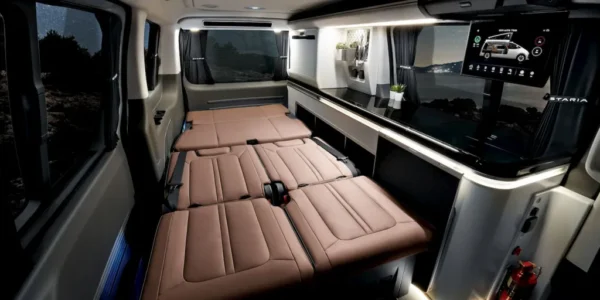
Inside, the camper is equipped for extended stays:
A 36-liter refrigerator
Portable showerhead
Dedicated climate control system
A compact kitchen area revealed when the pop-up roof opens
The rear features smart glass, adjustable via a touchscreen to control light, privacy, and UV exposure—an upscale touch rarely seen in camper vans.
Does it fit real-world travel needs?
Europe: This is clearly the camper’s natural home. Shorter travel distances, dense charging networks, and a strong camper-van culture make the Staria Electric Camper well-suited for European families and couples.
Canada & Australia: Both markets could benefit from the quiet, off-grid capabilities, but long distances and sparse charging in remote areas may test the 400 km range. The solar setup helps with living needs, but not enough to replace frequent charging on extended routes.
United States: Expectations should be tempered. Hyundai has stated the concept is tailored for Europe, and the gas-powered Staria isn’t sold in the U.S. American road trips often involve longer highway stretches and larger RVs, which may limit the camper’s appeal unless range and charging access improve significantly.
Final outlook
The Hyundai Staria Electric Camper Concept feels like a glimpse of where electric travel could go, rather than a fully market-ready solution for every region. Its fast charging, solar integration, and smart interior make it compelling for Europe—and potentially parts of Canada and Australia—but range and market availability remain key hurdles elsewhere.
If Hyundai brings this camper to production, it won’t replace traditional RVs overnight. But for families seeking quiet, clean, and tech-driven travel, it could mark the beginning of a new era in electric adventure—one that prioritizes experience over excess.