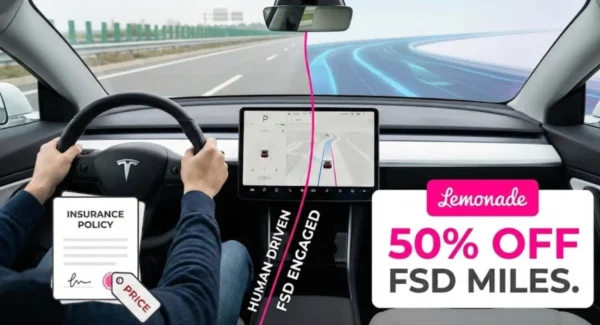
Lemonade has launched what it calls “Autonomous Car Insurance,” a product it describes as the first of its kind. For Tesla owners, the headline number is striking: insurance premiums can drop by around 50% when Full Self-Driving (FSD) is actively engaged. On the surface, it sounds like a clear vote of confidence in autonomy—and a sharp challenge to traditional assumptions about risk behind the wheel.
The product applies specifically to Tesla vehicles and is made possible through a new technical collaboration with Tesla. For the first time, Lemonade has access to detailed vehicle telemetry data that had previously been closed off to third-party insurers. That data allows the insurer to distinguish between human-driven miles and miles driven with FSD engaged, and to price risk differently depending on who—or what—is actually in control.
For consumers, this shift matters more than the marketing language around “autonomous” driving. Insurance pricing has always been a blunt instrument, based on demographics, past claims, and broad assumptions about driver behaviour. What Lemonade is attempting is a move toward usage-based insurance that goes beyond mileage or braking habits and into the question drivers increasingly care about: am I safer when I let the software drive?
The size of the discount suggests Lemonade believes the answer is yes—at least under specific conditions. A 50% cut is not incremental; it is a statement that, statistically, the insurer expects significantly fewer or less severe claims when FSD is engaged. Notably, the discount undercuts what Tesla’s own insurance product offers, which makes this less about brand alignment and more about competitive pressure within the insurance market.
At the same time, the product exposes a tension that has followed Tesla’s autonomy narrative for years. Tesla has long argued that its driver-assistance and self-driving systems improve safety, yet independent verification has been limited and often controversial. Lemonade’s pricing move does not settle that debate, but it does introduce a real-world financial test. If claims data does not support the assumption of lower risk, the model will quickly become unsustainable.
For drivers, there are also trade-offs to consider. Lower premiums come at the cost of deeper data sharing. Telemetry access means insurers can see not just whether FSD is engaged, but potentially how, when, and where the car is driven. For some users, that level of transparency will feel like a fair exchange for cheaper insurance. For others, it may raise concerns about privacy and long-term data use.
More broadly, this launch hints at how autonomy—whether partial or full—could reshape insurance before it fully reshapes transportation. Instead of waiting for a future where humans are removed from the loop entirely, insurers are starting to price the transition period, where control shifts back and forth between driver and software. In that sense, Lemonade’s product is less about declaring autonomy “solved” and more about monetising the grey area in between.
The bigger question is whether this approach will change how people drive. If insurance becomes significantly cheaper when assistance systems are active, drivers may feel nudged toward using them more often, even when they are uncertain or uncomfortable. That behavioural shift could have safety implications of its own.
Ultimately, “Autonomous Car Insurance” is less a celebration of self-driving technology than a sign that insurers are ready to challenge long-held assumptions. For consumers, the promise is simple—pay less when the software takes over. Whether that promise holds up will depend not on marketing claims, but on what the data reveals once real-world crashes, repairs, and liability disputes start to accumulate.
If nothing else, Lemonade’s move forces a conversation the industry has avoided: not whether cars will someday drive themselves, but how risk should be priced while they only do so part of the time.