Mercedes-Benz has officially launched its first branded DC fast-charging stations in Canada, starting with three sites in British Columbia as part of a broader rollout around Metro Vancouver and Southern BC.
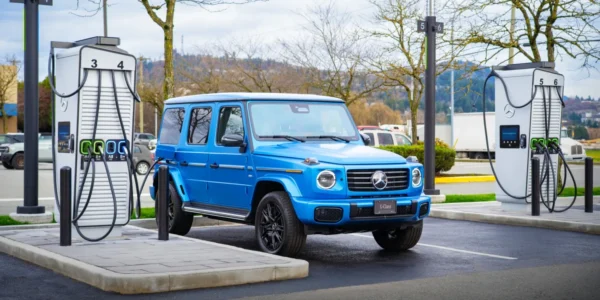
The new Mercedes-Benz High-Power Charging (HPC) locations are now live in Abbotsford, Pitt Meadows, and Tsawwassen. Five additional sites are planned in the coming months, which will bring the initial regional network to eight hubs spanning Greater Vancouver and key corridors in Southern British Columbia.
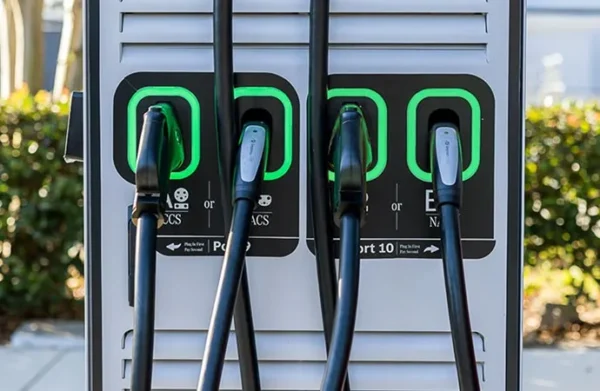
A notable feature of these stations is their uniform “four-cable” configuration. Every charging stall is equipped with both CCS-1 and NACS connectors, allowing EV drivers to plug in directly without adapters, regardless of which charging standard their vehicle uses. Mercedes-Benz says this approach is designed to remove uncertainty and friction from public charging, particularly as the industry transitions toward broader NACS adoption in North America.
According to Heiko Schmidt, President and CEO of Mercedes-Benz High-Power Charging North America and Canada, the goal is straightforward access: every stall supports every vehicle, with no extra steps required from the driver. This positions the network as brand-agnostic rather than exclusive, even though it carries Mercedes-Benz branding.
The charging hubs are being developed at retail and mixed-use destinations, with four of the eight locations built in partnership with BGO Properties. Planned and active sites include shopping centres, resorts, and highway-adjacent locations in Abbotsford, Coquitlam, Nanaimo, Penticton, Pitt Meadows, Squamish, Surrey, and Tsawwassen.
Each site uses Alpitronic HYC 400 DC fast chargers, capable of delivering up to 400 kW. While only a limited number of EVs can currently sustain charging at that level, Mercedes-Benz says future models—such as the upcoming electric GLC—could add roughly 300 km of range in around 10 minutes under optimal conditions. The stations also support Plug & Charge for compatible vehicles, enabling automatic authentication and billing without apps or cards.
The Canadian launch mirrors Mercedes-Benz’s strategy in the United States, where it has already deployed more than 650 charging stalls as part of its own public network. Rather than replacing third-party charging providers, the company appears to be positioning HPC as a complementary layer focused on reliability, consistency, and high power output.
Perspective
Mercedes-Benz’s move highlights a broader shift among legacy automakers toward direct involvement in charging infrastructure, particularly in regions where public charging reliability remains a concern. Whether branded networks like this meaningfully change day-to-day EV ownership will depend on uptime, pricing, and real-world performance—but the emphasis on universal compatibility suggests Mercedes-Benz is aiming to solve practical problems rather than simply make a branding statement.