Tesla has officially begun delivering the Tesla Cybertruck in the United Arab Emirates, marking the pickup’s first appearance in the Middle East and only its second international market after South Korea. On the surface, it looks like a confident step into new territory. Look closer, and it raises a more complicated question: is Tesla expanding because demand is strong—or because it needs new places where the Cybertruck can still be sold?
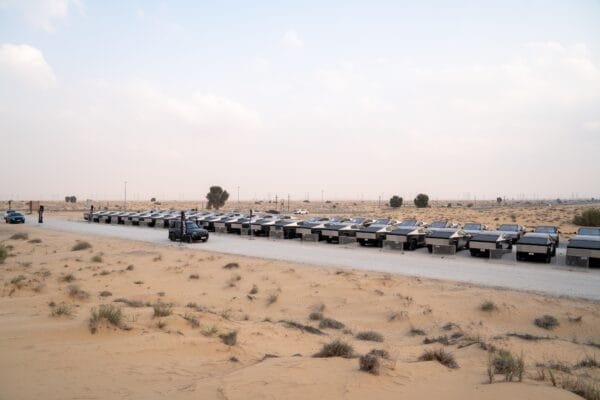
The launch itself was unmistakably theatrical. Roughly 60 Cybertrucks were handed over at an event in Dubai’s Al Marmoom desert, complete with light shows and carefully staged visuals. Tesla’s Europe & Middle East channels highlighted rows of stainless-steel trucks awaiting owners, signaling that the company sees the region as a showcase market. The UAE, with its appetite for bold, high-end vehicles, is an obvious fit from a branding perspective.
Pricing, however, tells a different story. In the UAE, the Cybertruck starts at around AED 404,900 (roughly $110,000) for the dual-motor AWD version, while the tri-motor Cyberbeast climbs to about $123,000. That represents a significant premium over US pricing—and an even starker contrast to the $39,900 base price Tesla originally promised back in 2019. What was once pitched as a disruptive, relatively affordable electric pickup has become a luxury novelty.
Tesla has also opened Cybertruck configurators across Saudi Arabia, Qatar, Jordan, and Israel, signaling a broader regional push. These markets share one critical advantage: they allow the Cybertruck largely as-is. Unlike Europe, where pedestrian safety rules, weight limits, and body design regulations effectively block the vehicle, Middle Eastern countries impose fewer constraints on unconventional designs.
First @cybertruck deliveries in the UAE 🇦🇪 pic.twitter.com/sN2rAxppUA
— Tesla Europe & Middle East (@teslaeurope) January 22, 2026
That regulatory reality helps explain Tesla’s geographic choices. Europe remains off-limits, with authorities citing the Cybertruck’s sharp-edged stainless-steel body and excessive weight as incompatible with safety standards. Even imported units have been seized in places like the UK. Faced with those barriers, Tesla is focusing on regions where approval is simpler and demand for eye-catching vehicles is stronger.
But expansion alone doesn’t tell the whole story. Cybertruck sales in the United States have fallen sharply, declining nearly 50% year over year in 2025, with an even steeper drop in late-year quarters. Those figures are far below CEO Elon Musk’s early projections of hundreds of thousands of units annually. Price inflation, shifting consumer preferences, and the truck’s polarizing design have all played a role.
So does the Cybertruck actually suit Middle Eastern buyers? In some ways, yes. The UAE market favors distinctive vehicles, has strong purchasing power, and offers wide roads and less restrictive regulations. For collectors and early adopters, the Cybertruck is more statement piece than work truck—and that aligns with how many will likely use it. Practicality, efficiency, and off-road utility may matter less than standing out.
My view is that Tesla’s Middle East rollout is both opportunity and pressure release. It’s a smart move to place the Cybertruck where it can legally sell and where novelty still carries weight. But it also underscores a deeper issue: the Cybertruck is finding its audience not as a mass-market pickup, but as a niche, high-priced curiosity. Expanding internationally may keep the model visible, but it won’t change its fundamentals. In the end, the Middle East launch feels less like the start of global domination—and more like Tesla ensuring the Cybertruck still has somewhere to go.