Tesla has expanded its lower-cost Tesla Model Y lineup in both Europe and Canada, introducing new “Standard” variants that significantly undercut existing Long Range and Premium trims. While the moves differ slightly by market—Europe receives a decontented Long Range option, while Canada gets a non–long range rear-wheel-drive version—the strategy behind them appears consistent: protect Model Y volume as price sensitivity rises.
A Response to Incentives and Competition
The timing matters. With EV incentives reduced or removed in key markets, Tesla can no longer rely on subsidies to bridge affordability gaps. Introducing stripped-back trims allows the company to lower headline prices without redesigning the vehicle or compromising production scale. In effect, Tesla is using content differentiation—rather than new hardware—to stay competitive.
Model Y Standard Long Range RWD now available in Europe
– 657 km of range (WLTP)
– 12.7 kWh per 100km (our most efficient Model Y to date!)
– 2118l cargo volume pic.twitter.com/58d19LaWsR
— Tesla Europe & Middle East (@teslaeurope) January 9, 2026
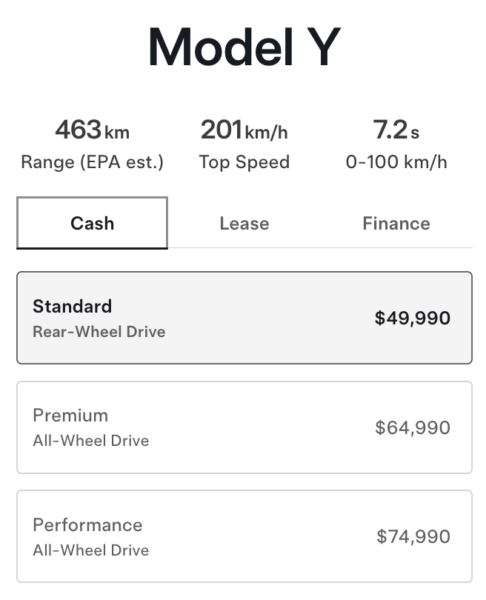
Canada illustrates this clearly. The Model Y Standard now starts at CAD $49,990, a substantial drop from the Long Range AWD Premium. At roughly USD $35,000, the Model Y enters price territory traditionally occupied by smaller crossovers, bringing Tesla’s best-selling SUV closer to mainstream budgets.
Specs vs. Real-World Use
On paper, the Canadian Model Y Standard looks modest by Tesla standards:
-
Estimated range: 463 km
-
0–100 km/h: 7.2 seconds
-
Top speed: 201 km/h
-
Drivetrain: RWD
These numbers won’t excite performance-focused buyers, but they align with everyday needs. For many households, 463 km of range and rear-wheel drive are sufficient for commuting and family use—especially when balanced against a lower purchase price.
In Europe, the picture is slightly different. Offering a “Standard” Long Range suggests Tesla is tailoring affordability without sacrificing range, likely reflecting higher expectations around motorway driving and longer intercity travel. It also points to Tesla’s willingness to fine-tune configurations by region rather than push a single global trim.
The Cost of Complexity
The downside is naming and lineup complexity. “Standard,” “Long Range,” “Premium,” and market-specific combinations blur distinctions that were once simple. For new buyers, understanding what they’re giving up—or gaining—requires more effort, particularly when features are removed quietly to hit price targets.
Still, Tesla may see this as an acceptable trade-off. By decontenting rather than redesigning, it preserves manufacturing efficiency and margins while adapting to local market pressures.
Supply Chain Flexibility
The near-simultaneous launches also highlight Tesla’s increasingly global supply chain. Canadian Model Y units now arriving from Europe allow Tesla to rebalance production as regional demand shifts—an advantage as EV markets become less predictable. This flexibility may prove as important as pricing in the years ahead.
Competitive Context
At these prices, the Model Y Standard pressures rivals across multiple segments. Traditional automakers offering compact or midsize electric SUVs must now contend with a Tesla that trades premium features for affordability—without abandoning its brand appeal or charging network advantage.
Perspective
Tesla’s latest Model Y variants suggest a strategic pivot toward volume defense rather than feature leadership. By broadening its entry points, Tesla is betting that affordability will matter more than trim simplicity or maximum performance in the next phase of EV adoption. Whether buyers embrace the added complexity—or push back against feature reductions—will determine if this approach becomes a short-term adjustment or a long-term template for Tesla’s global lineup.