Tesla has quietly but decisively changed what new buyers get for free. Effective immediately, Basic Autopilot is no longer included as standard on new Tesla Model 3 and Tesla Model Y orders in North America. For customers, the impact is simple and immediate: lane-keeping, once a default feature, is now locked behind a $99-per-month subscription to Full Self-Driving (Supervised).
For nearly seven years, Tesla’s definition of “standard” included two core driver-assistance features. Traffic-Aware Cruise Control adjusted speed to match surrounding traffic, while Autosteer kept the car centered in its lane on highways. Under Tesla’s new 2026 pricing structure, that second function disappears from the base package. New vehicles now ship with cruise control only. If buyers want the car to steer itself—even in basic highway scenarios—they must pay monthly.
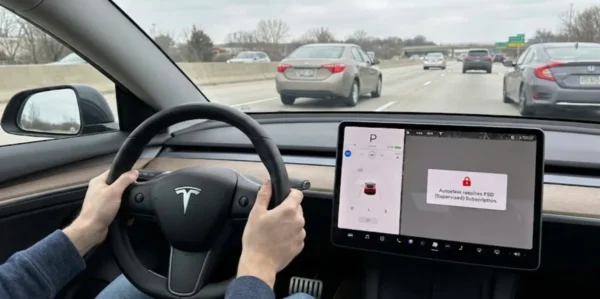
On paper, this may look like a small software tweak. In practice, it fundamentally changes the ownership experience. Lane centering has become an expected feature across much of the industry, often bundled at no extra cost. Removing it creates a noticeable gap between what drivers expect modern vehicles to do and what Tesla now offers by default.
The timing is telling. Just weeks ago, Tesla announced it would stop selling Full Self-Driving as a one-time purchase, moving entirely to a subscription-only model. Eliminating the free tier of Autopilot appears to be the next step in that transition. By narrowing the standard feature set, Tesla increases the pressure on buyers to subscribe—especially those who have grown accustomed to Autosteer during test drives or previous ownership.
From Tesla’s perspective, the strategy makes financial sense. Subscription revenue is recurring, predictable, and attractive to investors, particularly as vehicle margins come under pressure. Tesla has long hinted that Full Self-Driving pricing could rise as the software improves, a point often emphasized by CEO Elon Musk. But the current move feels less about future value and more about immediate uptake. Reports suggest that the percentage of owners paying for FSD remains relatively low, despite years of development and promotion.
For buyers, the change raises uncomfortable questions. Paying extra for advanced autonomy is one thing; paying to regain functionality that was once standard feels different. Over time, this could reshape how consumers perceive Tesla’s value proposition, especially as competitors continue to include lane-keeping systems at no additional cost.
There is also a broader implication for the industry. Tesla has often set expectations that others follow, particularly around software-driven features. If customers accept paying monthly for basic driver assistance, it could encourage similar moves elsewhere. If they push back, Tesla may be forced to rethink how far it can go in monetizing everyday functionality.
Ultimately, removing free Autopilot signals a shift in priorities. Tesla is no longer using standard driver assistance as a selling point, but as a lever. Whether that lever boosts revenue or erodes goodwill will depend on how much patience buyers have left for subscriptions—and how essential lane-keeping has become to modern driving.