Toyota has been talking about a three-row electric SUV for years, and now it finally feels real. A recent teaser image showing “something new on the horizon” strongly suggests the first public hint of Toyota’s long-promised large electric SUV—widely expected to be an all-electric Highlander, or something very close to it.
The timing is notable. Toyota first announced plans nearly three years ago to build a three-row EV in the US, originally targeting production at its Princeton, Indiana plant by the end of 2025. That plan was quietly pushed back as Toyota prioritized ramping up production of the gas-powered Grand Highlander, which has been selling extremely well. Now, the electric version is set to be built in Georgetown, Kentucky, with production expected to begin later this year and a likely debut as a 2027 model.
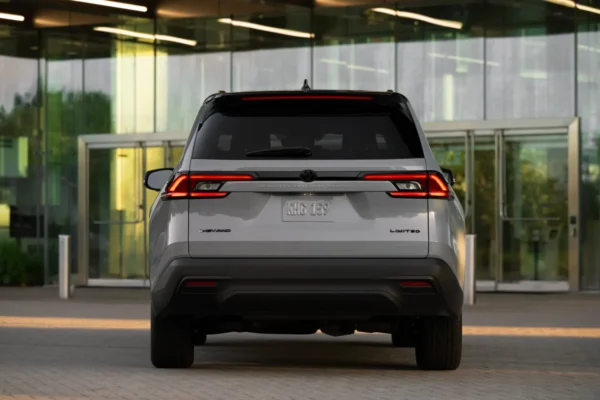
The teaser image itself doesn’t reveal much—but it doesn’t need to. The silhouette is unmistakably large and upright, closely mirroring the Grand Highlander’s proportions. A full-width LED light bar and smoother surfacing hint at EV-specific design tweaks, but Toyota is clearly not reinventing the wheel here. Instead, it appears to be translating a familiar, popular SUV shape into electric form.
That approach makes sense, especially for North America. In the US and Canada, three-row SUVs remain one of the most important family vehicle segments. Buyers value space, comfort, and familiarity over radical styling. An electric Highlander—if priced competitively and offering respectable range—could slot naturally into garages currently occupied by gas-powered Highlanders and Grand Highlanders.
Toyota’s evolving EV naming strategy also points in this direction. With the company dropping numeric badges like “bZ4X” in favor of simpler names, the three-row model could arrive as the bZ Highlander or something similar. That would give Toyota a clearer, more intuitive EV lineup: the bZ as a mid-size two-row SUV, the C-HR as a smaller crossover, and the Highlander EV as the family hauler.
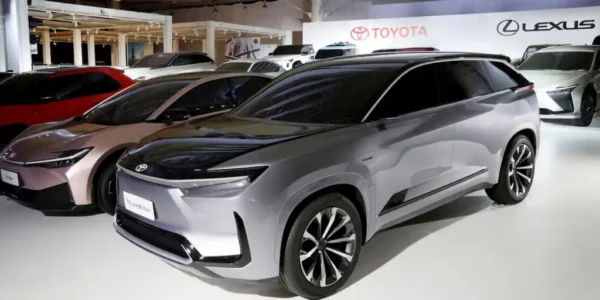
Competition, however, will be fierce. By the time Toyota’s three-row EV arrives, the segment will already be well populated by the Kia EV9, Hyundai IONIQ 9, Rivian R1S, and Volvo EX90. These rivals already offer long range, fast charging, and increasingly polished software experiences. Toyota’s challenge will be proving that its strengths—reliability, conservative engineering, and brand trust—still matter in an EV market that’s moving fast.
Regionally, the Highlander EV makes the most sense in the US and Canada, where three-row SUVs dominate family transport. In Europe, its size may limit appeal outside niche markets, where narrower roads and higher energy costs favor smaller vehicles. Australia sits somewhere in between: large SUVs sell well, but EV infrastructure and pricing will play a major role in adoption.
My view is that Toyota’s three-row electric SUV won’t be a headline-grabber—but it doesn’t need to be. If Toyota delivers a familiar, dependable electric family SUV with competitive range and pricing, it could quietly become one of the most important EVs in its lineup. The real question isn’t whether Toyota can build it—but whether it can arrive soon enough to matter in a segment that’s no longer waiting.