Hyundai Motor Company’s largest electric SUV is proving that market context matters. The Hyundai IONIQ 9 has been a clear success in South Korea, outselling the Kia EV9 by more than five to one in 2025. With 8,227 units sold domestically versus Kia’s 1,549 EV9s, Hyundai’s three-row EV has quickly carved out a strong position at home.
Several factors explain that momentum. In Korea, the IONIQ 9 starts at around 60 million won (roughly $41,500), making it competitively priced against large gasoline SUVs. Its generous range of up to 532 km, spacious interior, and practical features like vehicle-to-load (V2L) functionality have resonated with family buyers. For many Korean consumers, the IONIQ 9 feels like a logical upgrade from traditional three-row SUVs rather than a niche EV experiment.

The picture changes in the US. Since launching mid-year, Hyundai has sold just over 5,000 units, while Kia moved more than 15,000 EV9s in 2025, despite a year-over-year decline. Pricing is a key difference. The IONIQ 9 starts at $60,655 in the US, positioning it firmly in premium territory. At that level, buyers are cross-shopping not just with the EV9 but also with established ICE SUVs and even the Tesla Model X.
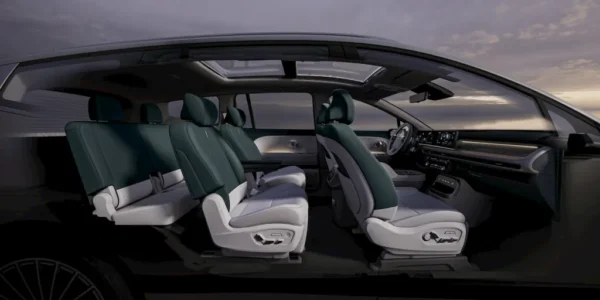
On paper, the IONIQ 9 competes well: up to 335 miles of range, nearly 87 cubic feet of cargo space, 350 kW fast charging capability, and a built-in NACS port for Tesla Supercharger access. But in the American market, brand positioning and dealer presence can weigh as heavily as specs.
My view? The IONIQ 9’s success in Korea shows the product works. Its slower US uptake likely reflects pricing and competitive dynamics rather than flaws in the vehicle itself. Whether Hyundai can replicate its home-market momentum abroad will depend largely on how aggressively it positions the SUV in a crowded premium EV segment.