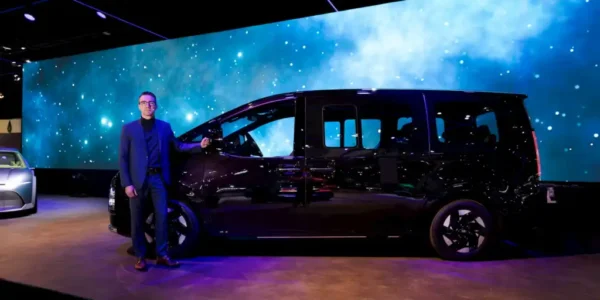
When Hyundai unveiled the Hyundai Staria EV at the Brussels Motor Show earlier this month, it quietly reminded the market that electrification doesn’t have to follow the SUV-only playbook. Instead of shrinking batteries into familiar crossover shapes, Hyundai has gone all-in on a large, purpose-built electric MPV — and that choice says a lot about where it sees unmet demand.
At over 5.25 meters long, the Staria EV is even larger than Hyundai’s own Hyundai IONIQ 9, offering true three-row space and up to 1,303 liters of cargo behind the third row. Its flat-floor, lounge-style interior and sliding doors make it far more practical for families, shuttle services, and businesses than most electric SUVs that prioritize styling over usability. Features like dual 12.3-inch screens, fast 800V charging, and Vehicle-to-Load further underline that this isn’t a stripped-down people mover.
In its segment, the Staria EV will inevitably be compared to electric vans and MPVs like the Kia PV5 Passenger, Volkswagen ID. Buzz, and various electric shuttle vans from Chinese brands. Compared to the retro-styled ID. Buzz, Hyundai’s approach is more futuristic and functional. Against Kia’s PV5, the Staria leans more toward comfort and passenger experience rather than modular commercial flexibility.
Regionally, the fit varies. Europe looks like the strongest market. MPVs still have a loyal audience there, especially for family travel, ride-hailing, and hotel shuttles, and stricter emissions rules favor large EVs with fast charging. Canada could also be a good match, particularly for commercial fleets and large families, though winter range and pricing will matter.
Australia is an interesting wildcard. Vans and people movers are popular for tourism and trades, and the Staria’s size and V2L capability could appeal strongly outside dense cities. The biggest question mark is the United States. With the gas-powered Staria not sold there, Hyundai lacks brand familiarity for the nameplate. Combined with America’s SUV-first mindset, a US launch looks unlikely — at least initially.
In my view, the Staria EV is a confident, slightly contrarian move. Hyundai isn’t chasing trends; it’s solving real space and usability problems that SUVs often ignore. It may never be a volume seller everywhere, but in the right markets, the Staria EV could become exactly what electric mobility needs more of: vehicles designed around people, not just proportions.