Electric vehicle infrastructure is evolving rapidly across the United States, but a small city in Georgia may have just introduced a unique twist to the concept of public charging. The Alpharetta, Georgia has installed what appears to be a city-branded Tesla Supercharger station — potentially the first example of a municipality directly deploying Tesla’s fast-charging technology under its own public infrastructure program.
Located near the city’s Department of Public Safety on Old Milton Parkway, the charging site includes four V3.5 Supercharger stalls capable of delivering up to 325 kW of power. What makes the installation particularly notable is the branding printed directly on the equipment, identifying it as a public charging station operated by the City of Alpharetta.
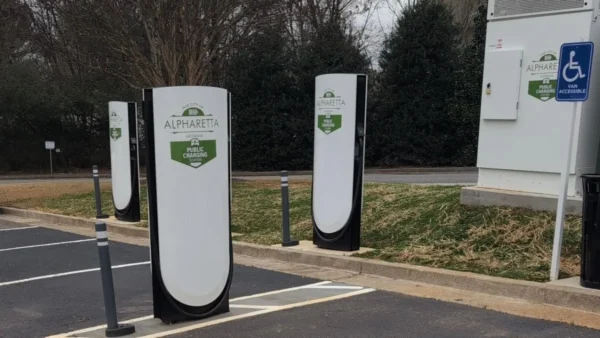
The project was implemented through Tesla’s Supercharger for Business program, which allows third parties — including property owners, companies, and local governments — to host Tesla’s high-speed charging hardware while relying on Tesla’s network integration, payment systems, and maintenance support. This hybrid approach effectively allows cities to expand EV charging infrastructure without needing to build and manage a charging network from scratch.
For Alpharetta, the chargers serve a dual purpose. They support the city’s growing fleet of Tesla Model Y police vehicles, while remaining open to the general public. This is particularly important for police operations. Traditional Level 2 chargers previously used by the department required several hours for a full recharge, creating downtime that can disrupt patrol schedules. With DC fast charging, officers can add substantial range in minutes rather than hours.
New City of Alpharetta Supercharger: Alpharetta, GA – Old Milton Parkway (4 stalls) https://t.co/ohMohERfZe
Learn more about Supercharger for Business: https://t.co/sWpIJRrJTy pic.twitter.com/Mdks161jjR
— Tesla Charging (@TeslaCharging) March 7, 2026
Beyond operational efficiency, the project may also represent a new financial model for municipal EV infrastructure. By allowing public access to the chargers, the city could generate revenue from charging sessions — helping offset installation and infrastructure costs. This approach transforms charging stations from purely operational assets into potential revenue-generating public utilities.
More broadly, Alpharetta’s strategy hints at how local governments might accelerate EV adoption. Rather than building dedicated chargers only for government vehicles, cities could deploy shared fast-charging hubs that benefit both municipal fleets and the public.
Final perspective: If Alpharetta’s experiment proves successful, it could inspire other municipalities to follow a similar model. City-owned fast chargers integrated with established networks like Tesla’s may offer a practical path to expanding EV infrastructure while supporting fleet electrification and generating public revenue at the same time.