For years, solid-state batteries have been described as the “holy grail” of electric vehicle technology — promising longer range, faster charging, and improved safety. Now, that vision is starting to move beyond theory. Major Chinese automakers and battery giants are accelerating development, with real-world testing already underway and commercialization timelines coming into focus.
From Lab Breakthroughs to Real-World Testing
Leading battery manufacturers like BYD and CATL — together responsible for more than half of global EV battery supply — are targeting small-scale production by 2027. That alone signals how seriously the industry is taking this technology.
But some automakers aren’t waiting. Dongfeng Motor has already begun testing solid-state battery prototypes in extreme cold conditions, achieving an energy density of around 350 Wh/kg and claiming a driving range exceeding 1,000 km (CLTC).
Meanwhile, Changan Automobile is pushing even further. Its upcoming “Golden Bell” battery is expected to reach 400 Wh/kg, with a theoretical range of up to 1,500 km (CLTC) — a figure that, if realized in real-world conditions, would redefine what drivers expect from EVs.
Chery Enters the Race With Bold Claims
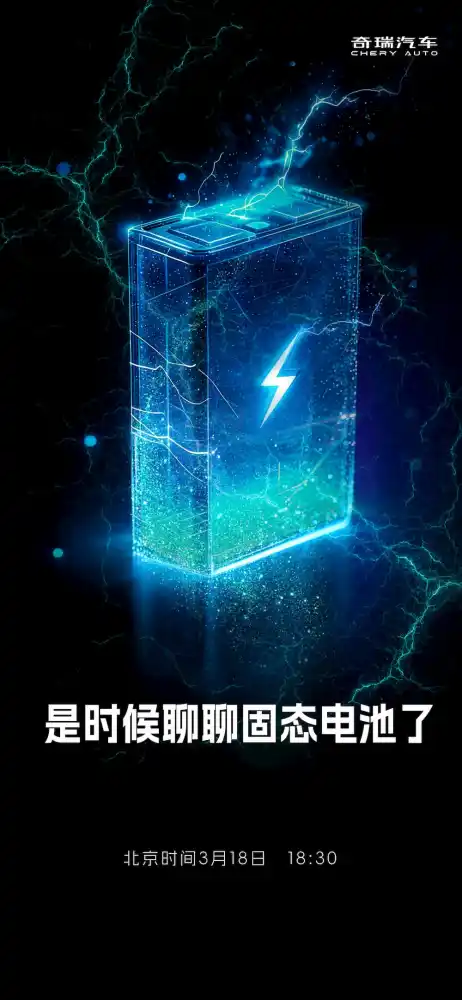
Chery is the latest to join the race, preparing to showcase its progress at a dedicated “Battery Night” event. The company has already teased prototypes with energy densities as high as 600 Wh/kg, an eye-catching number that could potentially double the performance of today’s lithium-ion batteries.
Chery plans to begin limited real-world testing later this year, with ambitions to scale toward mass-market applications by 2027 — aligning with broader industry timelines.
How Does This Compare to Current EV Batteries?
Today’s mainstream EVs typically rely on lithium-ion batteries with energy densities in the range of 150–250 Wh/kg. Even advanced LFP batteries, while safer and cheaper, still fall short in terms of energy density.
If solid-state batteries can reliably deliver 350–600 Wh/kg, the implications are massive:
-
Range could double without increasing battery size
-
Charging times could shrink significantly
-
Safety improves, as solid electrolytes reduce fire risks
However, there’s still a gap between lab results and real-world performance. Factors like cost, durability, and large-scale manufacturing remain major challenges.
A New Competitive Battlefield
What’s striking is how quickly Chinese automakers are moving. Compared to traditional automakers in Europe and the US, China’s EV ecosystem appears more aggressive in pushing solid-state technology toward commercialization.
This mirrors what we’ve already seen with LFP batteries and fast-charging infrastructure — areas where Chinese companies have taken a clear lead.
Final Thoughts
Solid-state batteries are no longer just a futuristic concept — they are entering a critical transition phase. The next two to three years will determine whether this technology can scale beyond prototypes and into mass production.
In my view, while the performance claims are impressive, caution is still warranted. The history of battery innovation is filled with breakthroughs that took far longer to commercialize than expected. Still, if even a portion of these promises materialize, solid-state batteries could fundamentally reshape the EV market — not just by improving range, but by removing one of the biggest psychological barriers to EV adoption.