Tesla has quietly revealed a new patent that offers a deeper look into how it may solve one of the biggest limitations of electric vehicles: range under real-world conditions, especially when towing.
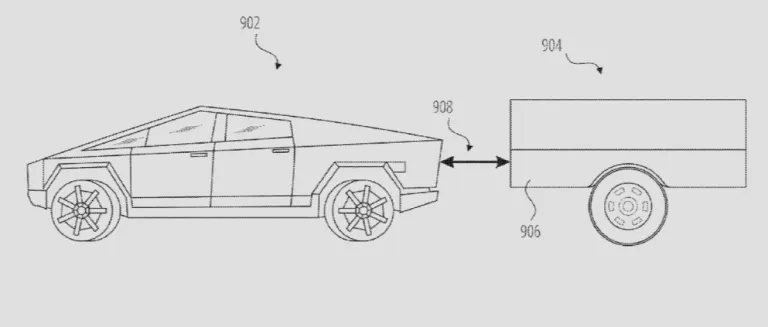
Filed in August 2024 and published in early 2026, the patent outlines a dual-battery management system that integrates an auxiliary battery with the main pack — including a configuration where the second battery is mounted inside a trailer.
What stands out is not just the idea of adding extra battery capacity, but how intelligently Tesla plans to manage it.
Core Concept: Two Batteries, One Intelligent System
At the heart of the patent is a system that connects:
- A primary 800V battery pack
- An auxiliary 400V battery pack
These are linked through dual DC/DC converters, allowing power to flow efficiently between the two systems despite their different voltages.
This setup enables Tesla to dynamically balance energy use, rather than simply draining one battery after the other — a key difference from simpler range extender concepts.
Three Operating Modes: Smarter Energy Management
The system operates through three distinct modes, each designed for a specific driving scenario.
1. State of Energy (SOE) Balancing
During normal driving, the system distributes energy usage between both battery packs based on their available charge.
Instead of depleting the auxiliary pack first, both batteries drain proportionally. This helps:
- Maintain efficiency
- Reduce stress on individual cells
- Extend battery lifespan
2. Open Circuit Voltage (OCV) Matching
When the vehicle detects an upcoming fast-charging stop, it prepares both batteries by aligning their voltage levels.
This is a critical step because mismatched voltages can limit charging efficiency or create safety risks. By equalizing voltage in advance, Tesla ensures both packs are ready to charge together.
3. Parallel Charging
Once conditions are optimized, both battery packs charge simultaneously at DC fast chargers ranging from 50 kW to 500+ kW.
This allows the system to:
- Maximize charging speed
- Reduce downtime
- Improve long-distance usability
The Most Interesting Idea: A Trailer-Based Battery Pack
Tesla describes two possible configurations:
- A battery mounted in the vehicle (like the original Cybertruck concept)
- A battery integrated into a trailer
The trailer-based approach is particularly compelling.
Unlike a bed-mounted battery, which reduces cargo space and requires installation at service centers, a trailer:
- Preserves full cargo capacity
- Can be attached or removed easily
- Is ideal for long-distance towing, where EV range drops significantly
This directly addresses the practical issues that led to the cancellation of the Cybertruck’s original range extender.
Thermal Management: A Clever Engineering Detail
One of the more subtle but important innovations is thermal control.
The system can:
- Generate heat through controlled energy losses in DC/DC conversion
- Use that heat to warm the auxiliary battery in cold weather
This eliminates the need for a separate heating system, simplifying the design while improving cold-weather performance.
Additionally, the patent includes:
- A coolant loop connected to the main vehicle system
- Heat exchangers and circulation pumps
- A dedicated heater for extreme conditions
Solar Integration and Energy Flexibility
Another notable feature is support for solar charging via MC4 connectors, allowing panels mounted on the trailer to trickle-charge the auxiliary battery.
While this won’t replace conventional charging, it adds a layer of energy independence — especially useful for camping or off-grid scenarios.
How This Differs from Earlier Concepts
Tesla is not the first to explore removable battery systems. Rivian, for example, filed a similar concept years earlier.
However, Tesla’s approach is different:
- Focus on software and power management architecture
- Advanced coordination between battery systems
- Integration with navigation and charging infrastructure
This suggests Tesla is less interested in the hardware itself and more focused on how the system behaves in real-world use.
Real-World Context: Why This Matters Now
The timing of the patent is notable.
It was filed when Tesla was still promoting the Cybertruck range extender — before quietly cancelling it in 2025. That suggests Tesla continued refining the underlying technology even after abandoning the original product concept.
This is typical of Tesla’s approach: iterate on ideas until the implementation becomes practical.
Technical Assessment: Strengths and Challenges
Strengths:
- Flexible range extension without redesigning the vehicle
- Smarter energy management than traditional add-on batteries
- Practical solution for towing scenarios
- Improved cold-weather performance
Challenges:
- Added system complexity
- Trailer dependency limits everyday usability
- Infrastructure and compatibility questions
- Real-world efficiency still unproven
Final Verdict: A Smart Idea That Needs the Right Execution
Tesla’s dual-battery patent presents a thoughtful and technically sophisticated approach to extending EV range — especially in scenarios where current electric vehicles struggle the most.
The trailer-based battery concept is particularly interesting because it solves real usability issues rather than just adding capacity.
Clear opinion:
This is not a guaranteed product, but it is a strong indication of where EV engineering is heading. If Tesla can turn this system into a practical, user-friendly solution, it could redefine long-distance electric driving — especially for towing and heavy-duty use.