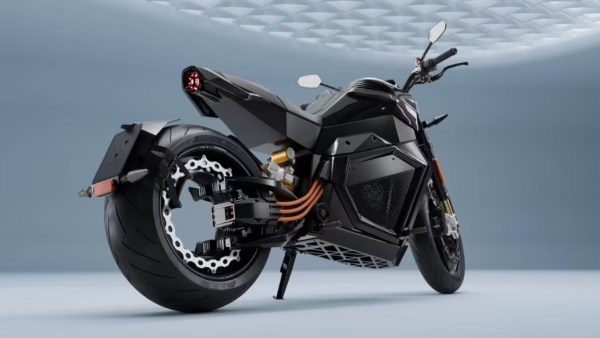
Verge Motorcycles has unveiled what it claims is the world’s first production-ready motorcycle powered by a solid-state battery, marking a notable milestone for electric two-wheelers. The announcement was made at the Consumer Electronics Show in Las Vegas on January 4, where Verge revealed a new variant of its TS Pro naked roadster.
The new model is said to deliver up to 180 miles of riding range after just 10 minutes of charging, a figure that—if realised in real-world use—would represent a significant leap over current lithium-ion systems.
Developed In-House, Not by Industry Giants
Rather than coming from an established battery heavyweight, the solid-state system has been developed by Donut Lab, Verge’s sister company, which operates out of Finland and Chippenham in the UK. The move underlines a broader trend of smaller, more agile firms pushing battery innovation ahead of traditional OEMs.
Verge says it will now offer two solid-state battery options, with plans to phase out lithium-ion cells entirely. Beyond faster charging, the company highlights longer battery lifespan and a reduced fire risk, thanks to the absence of liquid or gel electrolytes.
Two Battery Options, Same Platform
The smaller solid-state variant features an 18kWh battery, a claimed 225kg kerb weight, and charging capability of up to 100kW. When connected to a DC fast charger, Verge claims up to 124 miles (200km) of range can be added in 10 minutes, with a total range of up to 218 miles.
The larger option uses a 30kWh battery, weighs 235kg, and supports charging at up to 200kW. Verge claims this version can add 186 miles of range in 10 minutes, with a maximum range of up to 344 miles, depending on riding conditions.
Visually, both versions are said to be identical, aside from potential graphics differences.
Why Solid-State Matters
Unlike conventional lithium-ion batteries, which rely on liquid electrolytes, Verge’s new design uses a solid electrolyte, widely seen as a key step toward safer, more energy-dense batteries. The company has also moved away from cylindrical cells, instead using flat rectangular plates, which allow denser packaging and more efficient thermal management through internal cooling plates and external cooling fins.
However, Verge acknowledges that the headline charging figures depend heavily on access to ultra-fast charging infrastructure, which remains limited in many regions.
Building on the TS Pro Platform
The new solid-state models effectively leapfrog Verge’s recently updated lithium-ion TS Pro, shown at EICMA Milan last November. That version weighed 235kg, featured a lighter motor, an improved rider interface, and a 20.2kWh battery offering up to 217 miles of range, with fast charging taking under 35 minutes. Verge now says that model will be phased out rapidly following the solid-state breakthrough.
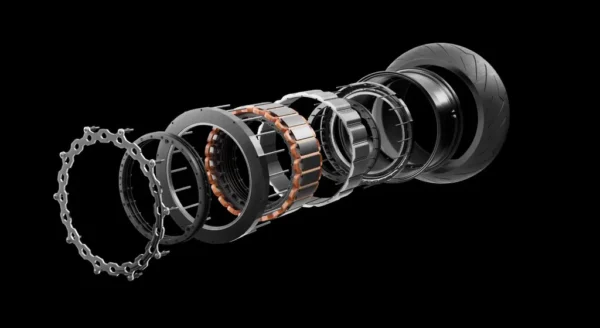
All versions continue to use Verge’s distinctive hubless rear wheel, incorporating the latest Donut Motor 2.0, launched in Milan last month. The electromagnetic design eliminates spokes and a central hub, using opposing magnetic fields to drive the wheel, with sealed bearings protecting against dirt and water ingress.
Perspective
From a neutral analytical standpoint, Verge’s announcement is more significant for what it demonstrates than what it immediately delivers. Solid-state batteries have long promised faster charging, higher energy density, and improved safety, but commercialisation has been slow. If Verge’s claims translate into reliable, repeatable real-world performance, this could represent a meaningful step forward for electric motorcycles.
That said, infrastructure limitations and long-term durability remain open questions. For now, Verge appears less like a disruptor of the mass market and more like a technology pathfinder—showing what may soon be possible as solid-state batteries move from theory to reality.