For years, Toyota has been the dominant force in Japan’s overall auto market—yet conspicuously absent from the country’s battery-electric vehicle (EV) conversation. That changed in late 2025, when Toyota overtook Nissan to become the top-selling domestic EV brand in Japan for the first time.
According to data from the Japan Automobile Manufacturers Association, domestic EV sales rose modestly by 1.6% in 2025 to 60,677 units. The headline, however, wasn’t overall market growth—it was Toyota’s sudden surge in the fourth quarter.
The bZ4X Reset
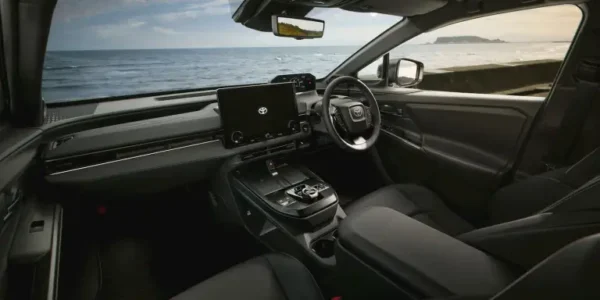
The catalyst was Toyota’s heavily updated Toyota bZ4X, relaunched in Japan in October. In Q4 alone, Toyota sold 3,448 units, representing a year-on-year increase of more than 2,100%. That single quarter was enough to push Toyota past Nissan in domestic EV sales rankings, according to Nikkei.
Crucially, this wasn’t driven by brand loyalty alone—it was the result of Toyota finally addressing the bZ4X’s early shortcomings. The revised model offers a 25% increase in range, now rated at 746 km, making it the longest-range domestic EV on sale in Japan. Faster charging, a redesigned interior and exterior, and a stronger feature set completed what many buyers saw as a long-overdue reset.
Just as important, Toyota repositioned the price. Starting at 4.8 million yen (around $30,600), the new bZ4X undercuts its predecessor, shifting it from a hesitant early-adopter product into something closer to the mainstream.
Timing and Market Psychology
Toyota’s rise also reflects broader shifts in Japanese EV buyer psychology. For years, early adopters gravitated toward Nissan, largely thanks to the Leaf’s first-mover advantage. But the domestic EV market has matured, and buyers are increasingly prioritising range, reliability, and brand confidence over novelty.
Toyota’s reputation—built on hybrids, quality control, and long-term ownership trust—has always been strong. What was missing was a competitive EV product that aligned with those expectations. Once that gap was closed, pent-up demand appeared quickly.
Nissan’s Relative Stagnation
While Toyota surged, Nissan slipped to third place among domestic brands, behind Honda, which ranked second after launching the N-ONE e in September. Nissan has effectively held Japan’s domestic EV crown for around 15 years, but its current lineup has seen fewer headline-grabbing updates, allowing rivals to catch up.
This doesn’t mean Nissan’s EV presence has collapsed—but it does suggest that leadership in a slow-moving market can erode quickly once competitors bring refreshed products with clearer value propositions.
Perspective
Toyota’s Q4 breakthrough doesn’t suddenly make it Japan’s EV champion in absolute terms, nor does it signal a dramatic shift away from hybrids overnight. Instead, it marks a strategic inflection point. By pairing meaningful technical improvements with sharper pricing and its well-established brand credibility, Toyota has shown it can compete—when it chooses to—on the EV stage.
Whether this momentum continues will depend on how quickly Toyota expands and refreshes its electric lineup. But for the first time, the question in Japan is no longer “why isn’t Toyota selling EVs?”—it’s “what happens if Toyota fully commits?”