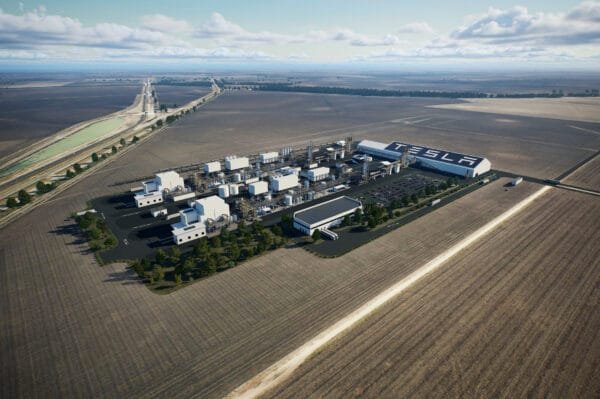
Tesla has released a new video offering a closer look at its massive lithium refinery in the Corpus Christi area of Texas, confirming that the facility has officially begun production. The update marks a significant milestone for the automaker as it moves deeper into the upstream side of the electric vehicle (EV) supply chain.
For several years, Tesla CEO Elon Musk has openly encouraged entrepreneurs to enter the lithium refining business, once calling it a “license to print money.” His argument was simple: while lithium resources are relatively abundant globally, the capacity to refine lithium into battery-grade lithium hydroxide has long been a critical bottleneck slowing EV adoption.
From warning to execution
Rather than waiting for the market to catch up, Tesla ultimately chose to act on its own warnings. In 2023, the company broke ground on a dedicated lithium refinery in Robstown, near Corpus Christi, aiming to deploy a new refining process designed to be faster, more efficient, and less resource-intensive than conventional methods.
Just two years later, Tesla is now showcasing the operational plant. In the newly released video, Jason Bevan, Tesla’s site manager for the project, walks viewers through the facility and confirms that production has officially begun—an unusually fast timeline for an industrial project of this scale.
Why lithium refining matters so much
Lithium refining sits at the heart of the EV value chain. Without sufficient refining capacity, automakers face higher costs, supply volatility, and geopolitical risk. By bringing refining in-house, Tesla is attempting to:
Stabilize long-term battery material supply
Reduce dependence on overseas processing, particularly from Asia
Lower cost per kilowatt-hour as EV volumes scale up
If Tesla’s new process performs as intended, it could also set a precedent for cleaner and more localized battery material production in the U.S., aligning with broader industrial and energy security goals.
Strategic implications for Tesla and the EV industry
This move reinforces Tesla’s long-standing strategy of vertical integration, extending control beyond vehicle assembly and battery manufacturing into raw material processing. In practical terms, it gives Tesla greater leverage over pricing, production planning, and future battery innovation.
For the wider EV industry, Tesla’s refinery raises the competitive bar. Other automakers may now face increased pressure to either secure long-term refining partnerships or pursue similar investments to avoid supply constraints as EV adoption accelerates.
Final outlook
Tesla’s Texas lithium refinery is more than a single facility coming online—it represents a strategic pivot toward supply chain self-reliance. If successful, it could help insulate Tesla from future lithium shortages while accelerating the broader transition to electric vehicles in the U.S.
Looking ahead, the real test will be scalability and consistency. Should Tesla prove it can refine battery-grade lithium efficiently and at scale, the company may not only reshape its own cost structure, but also influence how the next generation of EV infrastructure is built—starting far upstream, long before a car ever reaches the road.