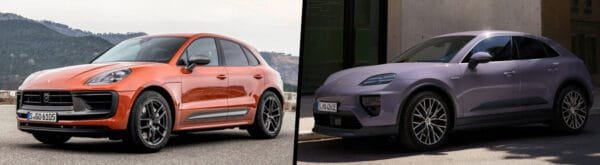
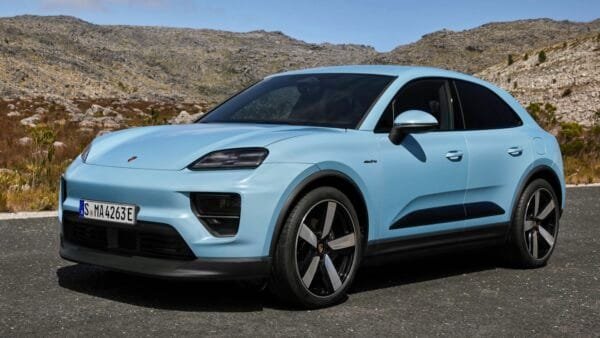
Porsche has released its full-year 2025 global sales results, and one data point stands out: the all-electric Macan outsold its combustion-engine counterpart. Notably, the Macan is the only Porsche model currently offered in both gas and fully electric versions, making it a rare, apples-to-apples comparison—and a telling one.
Across its lineup, Porsche’s electrified vehicles (BEVs + PHEVs) grew 7.4% year over year, even as total brand sales fell 10%. Fully electric models accounted for 22.2% of global deliveries, with plug-in hybrids adding another 12.1%. In Europe, the shift is even more pronounced: 57.9% of Porsche deliveries were plug-ins, and one-third were fully electric. Where no BEV exists (Cayenne, Panamera), the PHEV versions dominated.
The Macan as a real-world test
The Porsche Macan sold 84,328 units globally in 2025 (up 2%), with 45,367—or 53.8%—being electric. That slim majority becomes striking when placed in context: globally, roughly one in four new cars sold in 2025 was electric. Porsche is more than doubling that share with a single model where buyers can choose gas or electric without changing brands, size, or status.
In the U.S., about one-third of Macans sold were electric. While that’s still a minority, it far exceeds the national EV adoption rate (around 10%), especially during a year when EV growth slowed amid policy uncertainty and pricing pressure. The takeaway is clear: when performance, design, and brand identity are preserved, many buyers choose electric—even without mandates.
Not all EVs are equal
There’s nuance. The Porsche Taycan, Porsche’s first BEV, saw sales decline 22% in 2025. The Taycan launched in 2019, and despite new trims early in 2025, it’s showing age in a fast-moving segment. This contrast underscores an important lesson: EV success depends on product freshness and fit, not just powertrain.
What this means for consumers
For buyers, the Macan result signals lower risk in choosing electric from a performance brand. Resale confidence improves when demand is proven, and ownership benefits—quiet operation, instant torque, lower local emissions—come without sacrificing Porsche’s driving character. The strong European mix also suggests charging infrastructure and incentives matter, accelerating adoption where support is consistent.
Environmental impact, pragmatically
From an environmental perspective, shifting a best-selling luxury SUV line toward electricity reduces tailpipe emissions and local air pollution, especially in urban areas. While lifecycle impacts depend on electricity mix and battery sourcing, fleet-level electrification at this scale delivers measurable benefits over time—particularly as grids decarbonize.
An open question for Porsche’s strategy
Despite the Macan’s success, Porsche has recently extended combustion availability and delayed some future EV launches. The data presents a tension: customer behavior—at least with the Macan—supports faster electrification, yet the company is choosing a cautious, diversified path.
Final outlook: The electric Macan proves that EVs can win on merit in premium segments. If Porsche applies the same clarity—right product, right timing—to upcoming models, electrification can be both profitable and popular. Whether the brand accelerates that shift—or continues hedging—will shape not just its sales mix, but its environmental footprint in the years ahead.