In 2025, Porsche crossed a symbolic threshold on its home continent: battery-electric and plug-in hybrid models outsold traditional ICE vehicles in Europe, with nearly one in three Porsches sold globally being fully electric. It’s a milestone that says as much about consumer psychology as it does about product strategy.
This shift came during a challenging year overall. Porsche’s global deliveries fell more than 10%, from 310,718 units in 2024 to 279,449 in 2025. But company leadership appears relatively unfazed. According to Matthias Becker, the decline aligns with expectations and reflects supply gaps for combustion-engined 718 and Macan models, softer demand for ultra-luxury products in China, and Porsche’s continued focus on “value over volume.”
Europe: Where electrification feels natural
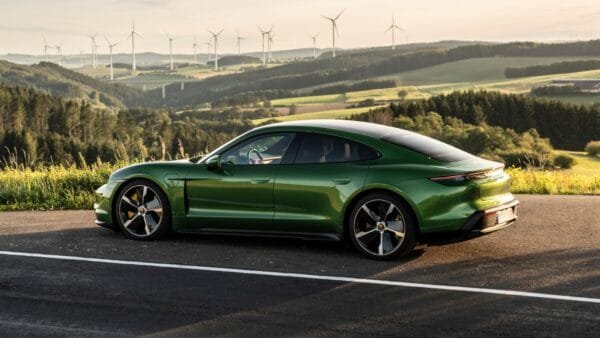
Europe stands out. In 2025, 57.9% of Porsche deliveries in Europe were plug-in vehicles, and about one-third were fully electric. Where no BEV option exists—such as the Cayenne and Panamera—plug-in hybrids dominated sales.
This isn’t just about regulations. European Porsche buyers increasingly view electrified drivetrains as enhancements, not compromises. Silent low-speed driving in cities, instant torque on winding roads, and favorable tax treatment all reinforce the perception that plug-ins fit modern European lifestyles. Crucially, Porsche’s electrified models preserve the brand’s core values—performance, design, and prestige—reducing the psychological friction that often accompanies switching powertrains.
North America: A different mindset
By contrast, North America remained Porsche’s largest single market, with sales essentially flat in 2025 (down less than 1%). Here, ICE models still dominate, and Porsche notably does not break out EV vs. ICE sales data for the U.S. and other emerging markets.
The reasons are layered. The expiration of the federal EV tax credit, shifting political priorities around emissions, and lower fuel prices all weaken the economic case for EVs. More importantly, many U.S. luxury buyers still associate engine sound and mechanical character with emotional value—especially in sports cars. For this audience, electrification must prove itself on experience alone, not policy incentives.
China and emerging markets: caution over conversion
China saw the steepest drop, down 26% year over year, reflecting weaker demand for high-end discretionary purchases. In emerging markets, sales were nearly flat, with ICE vehicles still making up the overwhelming majority. Here, charging infrastructure, resale uncertainty, and cost sensitivity continue to shape buyer hesitation toward plug-ins.
Buyer psychology is evolving—unevenly
What 2025 reveals is not a single global EV narrative, but regional stages of acceptance. In Europe, electrified Porsches are increasingly seen as the default future. In the U.S., they are still a choice—often weighed against nostalgia and perceived freedom. Elsewhere, they remain an aspiration constrained by infrastructure.
Porsche’s strategy reflects this reality. The company is proceeding with electrification—highlighted by launches like the Cayenne Electric—while carefully managing supply and margins as ICE models phase out.
Final outlook: patience over pressure
Porsche’s European results show that when electrification aligns with buyer identity, adoption can accelerate naturally. The challenge now is translating that confidence to markets where emotion, policy, and practicality pull in different directions. Rather than forcing the transition, Porsche appears content to let customer psychology catch up to technology—a slower path, perhaps, but one consistent with a brand built on restraint as much as performance.