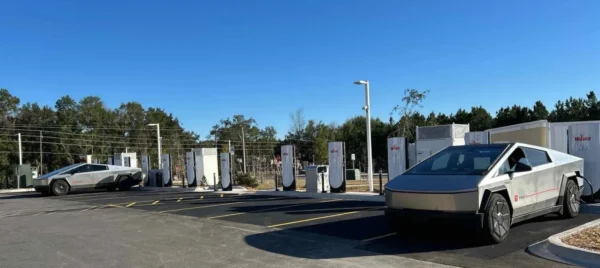
Wawa, already the largest host of Tesla Superchargers, has taken its partnership with Tesla a step further. By joining Tesla’s Supercharger for Business program, Wawa has launched its first self-owned and Wawa-branded Supercharger site, now live in Alachua, Florida, just northwest of Gainesville.
The move may look incremental, but it carries broader implications for EV charging economics, user experience, and environmental impact.
I first met Wawa leadership back in 2015. I took them for a drive in a Model S P85+ at their headquarters in Pennsylvania. The touchscreen and acceleration showed them how exciting EVs can be, and why they were the future. Conversations were kind, direct, and fun.
Just like they… https://t.co/JiyTpdudnW pic.twitter.com/IIBzn97tSI
— Max (@MdeZegher) January 17, 2026
From host to operator
Wawa and Tesla have worked together for more than a decade. Across the U.S., Wawa already hosts 223 Supercharger locations with 2,115 individual stalls—numbers that put it well ahead of any other retail partner. Until now, those sites were Tesla-owned and operated.
The Alachua location marks a shift. Under the Supercharger for Business program—launched in late November 2025—Tesla provides turnkey installation and ongoing management, while the site owner controls branding and pricing. At this new location, Wawa operates 16 high-power 325 kW stalls and sets the charging rate at $0.37 per kWh.
Tesla’s Director of Charging for North America, Max de Zegher, highlighted the long relationship between the two companies, recalling early conversations with Wawa leadership as far back as 2015—long before EVs went mainstream.
Why this matters for EV drivers
For users, the appeal is immediate and practical. Convenience stores are already ideal charging locations:
Clean restrooms
Food and drinks
Lighting and security
24/7 access
A fast charge often lines up perfectly with a coffee stop or quick meal. By owning and branding the chargers, Wawa gains an incentive to further optimize the experience—whether through better amenities, loyalty programs, or bundled offers tied to charging sessions.
Pricing control also matters. At $0.37/kWh, Wawa’s rate is competitive for high-speed DC charging, and future sites could adjust pricing based on local demand, time of day, or promotions.
How it started: How it’s going: pic.twitter.com/RLjKt6yJt8
— Nic Cruz Patane (@niccruzpatane) January 17, 2026
Environmental and infrastructure impact
From an environmental perspective, this model supports faster EV adoption by addressing one of the biggest barriers: charging confidence. When drivers know reliable fast charging is available at familiar, well-maintained locations, range anxiety drops.
Scaling this approach could also reduce congestion at standalone charging hubs by distributing high-power chargers across everyday destinations. With over 1,200 Wawa stores in 14 states and Washington, DC, the potential network effect is substantial—even if only a fraction become self-owned Supercharger sites.
While EV charging still depends on local electricity generation mix, increasing utilization of fast chargers at retail sites helps normalize EV travel and supports the broader transition away from combustion vehicles.
What’s next?
Wawa hasn’t disclosed how many additional self-branded Supercharger sites it plans to open. But the economics are compelling:
Increased foot traffic
Longer dwell times
New revenue stream from charging
For Tesla, the Supercharger for Business program enables rapid network expansion without owning every asset, while keeping the Supercharger experience consistent.
Final outlook
Wawa’s move from host to operator signals a maturing EV charging ecosystem—one where charging becomes a standard retail service rather than specialized infrastructure. For users, it promises more convenient, familiar places to charge. For the environment, it supports steady, practical EV adoption.
If this model scales, the future of fast charging may look less like isolated stations—and more like a natural extension of everyday stops we already make.