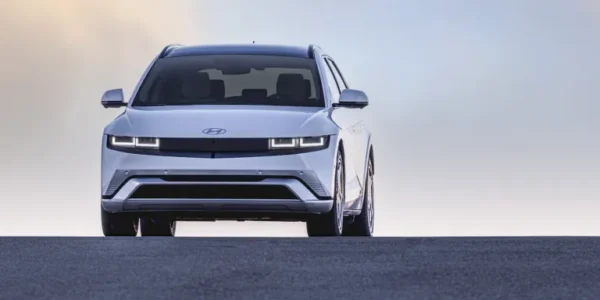
When Hyundai launched the Hyundai IONIQ 5 in the US in late 2021, it didn’t feel like a cautious first step. The sharp, retro-futuristic design, ultra-fast charging, and airy interior immediately set it apart from the early wave of electric crossovers. Four years on, the IONIQ 5 has proven that early excitement wasn’t a fluke—it has remained one of the most consistently popular EVs in its class.
For the 2025 and 2026 model years, Hyundai doubled down. US-built versions gained more range (up to 318 miles), refreshed styling, and a native NACS port, unlocking access to Tesla’s Supercharger network without adapters. When the federal $7,500 EV tax credit expired in late 2025, Hyundai responded aggressively, cutting prices by as much as $9,800. That move pushed the base 2026 IONIQ 5 to $35,000, reshaping its value proposition overnight.
Why it looks like the best EV deal in the US
That pricing is a major reason Kelley Blue Book named the 2026 IONIQ 5 its Best Overall Electric Vehicle. At $35,000, buyers get a well-built EV with a 245-mile EPA range, while stepping up to the SE RWD at $37,500 unlocks 318 miles, placing it squarely among long-range rivals costing far more.
Charging is another differentiator. Thanks to its 800V architecture, the IONIQ 5 can add up to 178 miles in about 15 minutes on a 350 kW DC fast charger—something few competitors at this price point can match. Combined with Supercharger access, that makes road trips far less intimidating for first-time EV buyers.
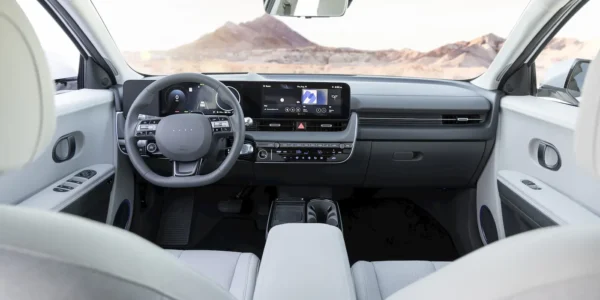
Inside, the IONIQ 5 continues to punch above its weight. Despite being similar in footprint to a Tucson, its long wheelbase delivers exceptional interior space—longer even than Hyundai’s three-row Palisade. The minimalist cabin, dual 12.3-inch displays, and standard wireless Apple CarPlay and Android Auto strike a balance between modern tech and everyday usability.
Does the same logic apply in Europe?
In Europe, the picture is more nuanced. The IONIQ 5 still competes strongly on charging speed and interior space, but pricing is less aggressive due to VAT, energy costs, and regional incentives. Against rivals like the Tesla Model Y, Volkswagen ID.4, and Skoda Enyaq, the IONIQ 5 stands out more for design and charging performance than outright affordability.
European buyers also tend to prioritize efficiency and compact dimensions, areas where some newer, slightly smaller EVs may feel better suited to dense cities. Still, few offer the IONIQ 5’s blend of fast charging, space, and distinctive styling.
Final outlook
In the US, it’s hard to argue with Hyundai’s positioning. At current prices, the IONIQ 5 genuinely delivers one of the strongest balances of range, technology, charging speed, and build quality for the money. In Europe, it may not always be the cheapest option, but it remains one of the most well-rounded.
Whether it’s truly “the best” depends on priorities—but as an all-around EV that avoids obvious compromises, the IONIQ 5 has earned its reputation rather than simply benefiting from it.