Volvo has unveiled the full design and specifications of the upcoming Volvo EX60, positioning it squarely in the upper-middle segment of its electric lineup. Sitting between the smaller EX30/EX40 and the larger Volvo EX90, the EX60 is intended to be a high-volume model that balances range, performance, and everyday usability rather than pushing into flagship territory.
On paper, charging and range are the EX60’s strongest selling points. Volvo says the EX60 is its fastest-charging and longest-range electric vehicle to date. On a 400 kW, 800-volt DC fast charger, the car can add up to 173 miles of range in 10 minutes. If those figures hold up in real-world testing, the EX60 would sit near the top of its class for charging performance, alongside models like the Tesla Model Y Performance and Hyundai Ioniq 5 N, while surpassing most European rivals that still cap fast-charging speeds closer to 200–250 kW.
In the US, the EX60 will also be the first Volvo to come standard with a NACS charging port, eliminating the need for adapters when using Tesla Superchargers. For buyers, this is less about branding and more about convenience: access to a wider and generally more reliable fast-charging network remains a practical advantage, especially for long-distance driving.
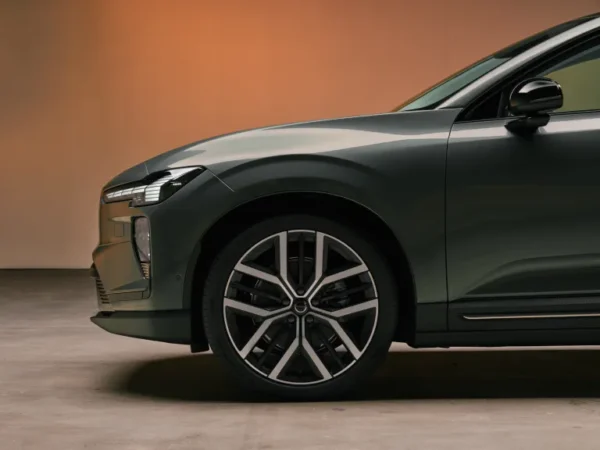
Volvo will offer three powertrain variants. The P6 rear-wheel-drive version delivers an estimated 310 miles of range from an 83 kWh battery, while the P10 all-wheel-drive model offers 320 miles from a 95 kWh pack. At the top of the range, the P12 AWD claims up to 400 miles of range thanks to a large 117 kWh battery. That figure is notably higher than most direct competitors, though it comes with trade-offs. Larger batteries increase vehicle weight, cost, and charging energy, and Volvo notes that opting for larger, less efficient wheels can reduce range by 25 to 100 miles depending on configuration.
All three versions support 10–80% fast charging in under 20 minutes on a sufficiently powerful charger and come with a 19.2 kW onboard AC charger, which is useful for overnight home charging—particularly for the largest battery option. Volvo also includes a 10-year battery warranty across the lineup, which should help address long-term ownership concerns.
In terms of size, the EX60 fits neatly into the premium midsize SUV category. It is noticeably larger than compact EVs like the Tesla Model Y or BMW iX1, but smaller and less imposing than full-size electric SUVs such as the BMW iX or Mercedes-Benz EQS SUV. This middle-ground sizing is likely to appeal to buyers who want more interior space and road presence without moving into the higher price brackets and parking challenges of larger models.
Performance is strong but not extreme. The base P6 reaches 0–60 mph in 5.7 seconds, which is competitive for the segment. The P10 improves that figure to 4.4 seconds, while the P12 drops it further to 3.8 seconds, placing it firmly in “quick but not overtly sporty” territory. Volvo appears to be prioritizing smooth, confident acceleration over outright performance theatrics.
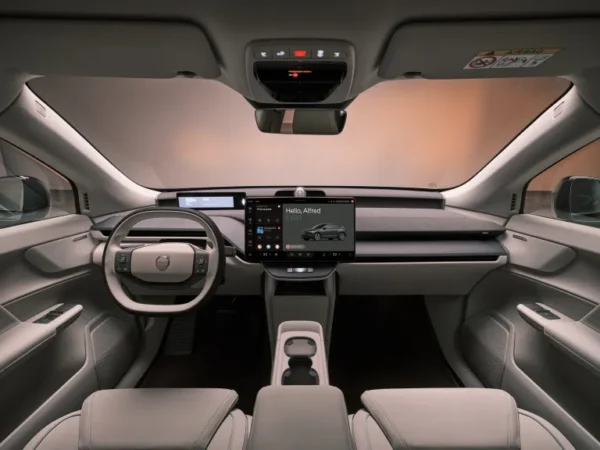
Inside, the EX60 follows Volvo’s familiar Scandinavian design language, emphasizing clean surfaces and minimal visual clutter. Storage is practical, with a front trunk for smaller items and additional underfloor storage in the rear. The infotainment system runs on NVIDIA’s DRIVE AGX Orin platform paired with a Qualcomm 8255 processor, with Google-based software and Gemini voice integration. Volvo claims a “no-lag” experience, though real-world responsiveness will be key, especially as many competitors have struggled with slow or inconsistent infotainment performance.
From a manufacturing and environmental perspective, Volvo highlights the EX60’s use of megacasting technology and higher-density batteries to reduce production complexity and carbon footprint. The company says the EX60’s total carbon impact is comparable to the smaller EX30, which, if accurate, would be notable given the EX60’s size and battery options.
Overall, the EX60 appears designed to compete on practical strengths—range, charging speed, and everyday usability—rather than radical design or cutting-edge autonomy. Its success will likely depend less on headline specifications and more on pricing, real-world efficiency, and how well Volvo executes on software reliability and charging performance once the car reaches customers.