FAW Group, China’s oldest domestic carmaker, has taken a significant step into the next phase of electric vehicle technology by beginning real-world testing of solid-state batteries. Founded in 1953, FAW’s history is deeply tied to China’s early automotive ambitions and decades of dominance built on internal combustion engines rather than rapid innovation.
For much of the modern era, FAW and its fellow state-owned giants—SAIC, Changan, and Dongfeng—controlled the market through scale and government backing. That advantage has eroded quickly in the EV age, where companies like BYD reshaped competition around batteries, software, and supply-chain control. FAW’s move into solid-state batteries should be seen against that backdrop: less a breakthrough announcement, and more a signal that legacy players are under pressure to reinvent themselves.
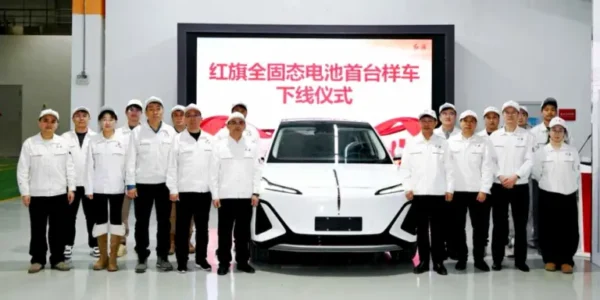
According to confirmation from Xinhua News Agency, the first FAW vehicle equipped with a solid-state battery has rolled off a pilot production line. The prototype is part of Hongqi, FAW’s premium brand, which has traditionally symbolized political prestige and conservative design rather than cutting-edge technology. That choice is telling. Solid-state batteries remain expensive and experimental, making luxury models the safest testing ground.
FAW says it reached several technical milestones after 470 days of research and development, including advances in sulfide electrolytes and higher-capacity battery cells. Its 66Ah all-solid-state cell has reportedly passed extreme heat testing at 200°C (392°F), while ionic conductivity exceeded 10 mS/cm—above that of conventional liquid electrolytes. Local media reports place the energy density at around 380 Wh/kg, far higher than today’s lithium-ion batteries, which typically range between 180 and 250 Wh/kg.
If those figures hold up beyond the lab, the implications are clear. Higher energy density could mean longer driving range, lighter vehicles, and improved safety, addressing several of the biggest trade-offs facing current EVs. But it also raises expectations that are notoriously difficult to meet once manufacturing scales up.
FAW’s announcement follows closely on similar news from Dongfeng Motors, another member of China’s “Big Four,” which recently began testing a solid-state battery prototype in extreme cold conditions. Dongfeng claims its battery delivers up to 350 Wh/kg and more than 620 miles of range under China’s CLTC cycle. Together, these developments suggest that solid-state batteries are moving out of research labs and into early vehicle testing—though still far from mass-market readiness.
FAW plans to introduce solid-state batteries in small batches for high-end Hongqi models by the end of 2027, with mass production targeted around 2030. The company has indicated that costs could fall by more than 50% once production scales, a claim that will be closely watched. Cost, not performance, remains the biggest obstacle to widespread adoption.
In the near term, solid-state batteries are unlikely to transform the EV market overnight. Manufacturing complexity, long-term durability, and yield rates are unresolved challenges. Early deployments will almost certainly be limited to premium vehicles, where higher prices can absorb technical risk.
The broader significance lies elsewhere. FAW’s move underscores how urgently China’s traditional automakers are trying to close the innovation gap. Solid-state batteries have become a strategic wager—less about immediate commercial success and more about relevance in the next decade.
The real test will not be whether FAW can demonstrate impressive numbers in controlled trials, but whether it can turn those results into reliable, affordable products at scale. Solid-state batteries may not be the instant revolution many hope for, but they are rapidly becoming the benchmark by which the future credibility of legacy automakers will be judged.