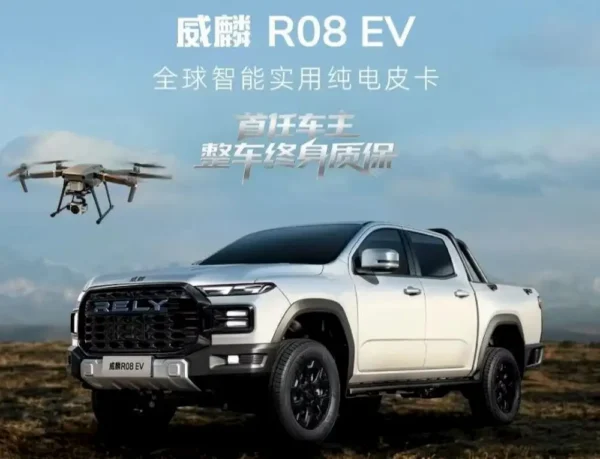
Chery Automotive has launched its first fully electric pickup, and the headline is impossible to ignore: it looks almost identical in size to a Toyota Hilux, yet starts at just 127,800 yuan (about $18,300). Sold under Chery’s new pickup-focused sub-brand Rely, the R08 EV isn’t trying to be subtle. It’s making a blunt statement about how fast electric pickups are becoming accessible in China.
Dimensionally, the Rely R08 sits squarely in the global midsize pickup segment. At roughly 5.33 meters long, it’s a near match for the Toyota Hilux, a truck that has defined the category for decades. But where the Hilux still leans heavily on diesel and hybrid powertrains, the R08 jumps straight to full electric—and at a fraction of the price.
The battery options tell a lot about Chery’s ambitions. Buyers can choose between a 66.5 kWh or 88 kWh pack, with rear-wheel drive or all-wheel drive depending on trim. Even the smaller battery claims up to 405 km CLTC in RWD form, while the AWD variants stretch beyond 500 km on China’s test cycle. Power is equally bold: 200 hp for the single-motor version, or up to 400 hp and 540 Nm of torque with dual motors. On paper, that’s far more muscle than most work-focused pickups need.
Inside, the R08 feels very much like a modern Chinese EV rather than a barebones work truck. Large infotainment screens, a Qualcomm Snapdragon 8155 chip, and optional ADAS features such as adaptive cruise and lane-keeping assistance push it closer to lifestyle pickup territory. This mirrors a broader trend in China, where pickups are increasingly marketed as dual-purpose vehicles rather than purely commercial tools.
In its home market, the value proposition is obvious. Even the most expensive R08 trim tops out under $23,000—less than half the price of a European-market Hilux. Compared with China’s other electric pickup, the Radar RD6 from Geely, the R08 competes on similar pricing but leans harder into a traditional pickup silhouette rather than crossover-inspired styling.
The bigger question is how a truck like this would fare outside China. In the US and Canada, price alone would grab attention, but regulatory hurdles, safety standards, and charging expectations would quickly complicate things. Range figures would need to be translated to EPA numbers, and towing and payload ratings—still unclear—would be critical. American buyers also expect a dense fast-charging network, something Chinese pickups aren’t designed around yet.
Europe presents a different challenge. There, the Hilux and Ford Ranger dominate thanks to durability and resale value. An electric alternative priced anywhere near €20,000 would be disruptive, but only if it could meet EU safety and homologation rules. Toyota’s own electric Hilux, with a much smaller battery and far higher expected price, shows how cautious legacy brands still are.
My view is that the Rely R08 isn’t meant to replace the Hilux—at least not yet. Instead, it shows how aggressively Chinese automakers are redefining the pickup equation. Low pricing, strong performance, and EV-first design give trucks like the R08 a clear edge in emerging markets. Whether it ever sells in the West, its existence alone puts pressure on global brands. Once electric pickups reach this price level at scale, the segment won’t look the same again.