Volkswagen Group’s strategic battery partner, Gotion High-Tech, has reached a milestone that could reshape the electric vehicle landscape: real-world vehicle testing of its GEMSTONE all-solid-state batteries, targeting a CLTC range of up to 1,000 km (620 miles).
Volkswagen’s €1 billion investment in Gotion in 2020 — securing a 26% stake — was widely seen as a long-term bet on next-generation battery chemistry. Now, that bet appears to be progressing beyond theory and pilot labs into practical automotive validation. After completing a 0.2 GWh pilot production line last year with a 90% yield rate, Gotion has “basically completed” the design of a larger 2 GWh solid-state production line. That signals a transition from experimental phase to early industrial scaling.
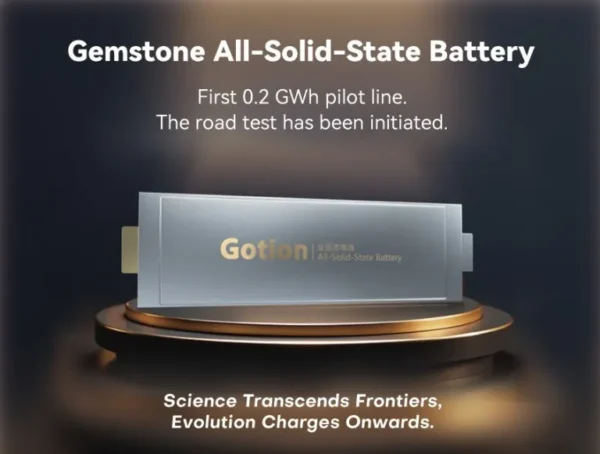
The technical claims are ambitious. The GEMSTONE solid-state battery reportedly achieves an energy density of 350 Wh/kg and a 70 Ah single-cell capacity. For context, most mainstream lithium iron phosphate (LFP) batteries today operate in the 160–200 Wh/kg range, while high-nickel lithium-ion packs typically sit around 250–300 Wh/kg at the cell level. If Gotion’s figures hold up in mass production, this would represent a significant leap in energy density — potentially enabling longer range without increasing pack size or weight.
Equally important is durability. Gotion says the batteries maintained performance in extreme temperatures from -40°C to 80°C. Thermal resilience is one of the biggest technical hurdles for solid-state chemistry, so demonstrating stability across such a wide range could strengthen confidence among automakers and regulators.
The company also reported notable material improvements: a 60% boost in sulfide electrolyte ion conductivity and a 150% increase in cell capacity compared to prior iterations. Meanwhile, its quasi-solid-state G-Yuan battery — rated at 300 Wh/kg — serves as a bridge technology, potentially offering high performance before full solid-state production matures.
Compared with other global efforts — including programs by Toyota, QuantumScape, and CATL — Gotion’s progress stands out because it is already moving toward scaled production infrastructure. However, 2 GWh remains relatively small compared to the hundreds of GWh required for mass-market EV deployment. The true challenge lies not in lab breakthroughs, but in cost control, manufacturing consistency, and long-term durability under real-world stress.
For Volkswagen and its brands, including Audi, access to a domestically developed Chinese solid-state platform could be strategically valuable, especially in the world’s largest EV market. It may also reduce reliance on traditional lithium-ion suppliers while positioning VW to compete in long-range premium EV segments.
In my view, this development is promising but still transitional. Solid-state batteries have long been described as the “holy grail” of EV technology, yet commercialization has repeatedly been delayed across the industry. Gotion’s move into vehicle testing is a meaningful step forward — but the real test will be scaling production affordably and reliably. If achieved, it could redefine range expectations and reshape global EV competition in the years ahead.