
Electric motorcycles have slowly begun carving out a place in the broader two-wheel market, but for traditional manufacturers the transition has been cautious. Kawasaki, in particular, has taken a measured approach. Its first production electric bikes, the Kawasaki Ninja e-1 and Kawasaki Z e-1, were clearly aimed at the entry-level commuter segment rather than pushing the boundaries of performance.
However, a newly surfaced patent suggests Kawasaki may already be exploring a more advanced direction for its electric motorcycle platform.
The patent describes a modular motor mounting concept that could significantly change how electric bikes are engineered within the company. Traditionally, many electric motorcycles are built around a tightly integrated powertrain. The battery pack and motor often serve as structural elements of the chassis itself. While this approach improves rigidity and packaging efficiency, it also locks manufacturers into a specific motor design. Changing the motor often means redesigning large portions of the frame.
Kawasaki’s patent proposes a different solution. Instead of attaching the motor directly to the main frame, the company introduces an intermediate subframe that acts as a mounting interface between the chassis and the motor-transmission unit. This subframe consists of two separate sections — upper and lower segments — which can be swapped or modified depending on the motor configuration.
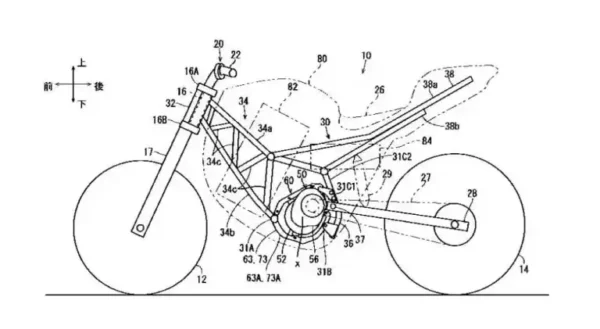
At first glance, the concept might sound simple, but its implications could be significant. By using a standardized main frame and interchangeable mounting structures, Kawasaki could theoretically build several electric motorcycle models using the same base architecture. Different motors — perhaps with varying power outputs, cooling systems, or transmission layouts — could be installed without redesigning the entire bike.
For a company still early in its electric motorcycle journey, that flexibility could be extremely valuable. Electric powertrains are evolving rapidly, and committing to a single fixed layout too early could become a limitation as technology improves.
A modular platform would also bring clear manufacturing advantages. Shared components across multiple models could streamline production and reduce engineering costs. That efficiency is particularly important in the electric motorcycle segment, where pricing remains one of the biggest barriers to wider adoption. Gas-powered motorcycles are still often significantly cheaper than their electric counterparts.
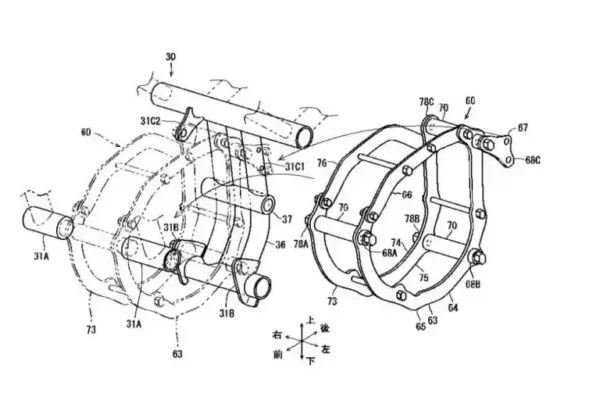
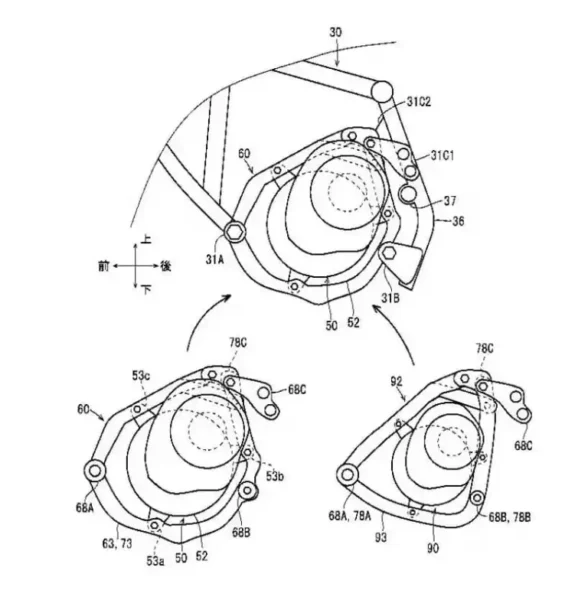
Another interesting aspect is how this design might support a broader range of future models. Kawasaki could potentially create everything from lightweight commuter EVs to higher-performance electric sportbikes using the same core chassis architecture, simply by adapting the subframe and motor package.
Final perspective: While patents do not always translate directly into production models, this concept hints at a thoughtful long-term strategy. Instead of rushing into high-performance electric motorcycles, Kawasaki appears to be quietly developing the engineering foundation needed to support an entire EV lineup. If implemented successfully, a modular platform like this could give the company both technical flexibility and cost advantages as the electric motorcycle market continues to evolve.