The race to commercialize next-generation batteries has produced no shortage of bold claims, but independent verification often tells a more nuanced story. Recently, Donut Lab released its third independent test report conducted by VTT Technical Research Centre of Finland, adding another piece of evidence to support its solid-state battery development. This time, the focus was on self-discharge performance — a critical factor for long-term energy retention in electric vehicles and energy storage systems.
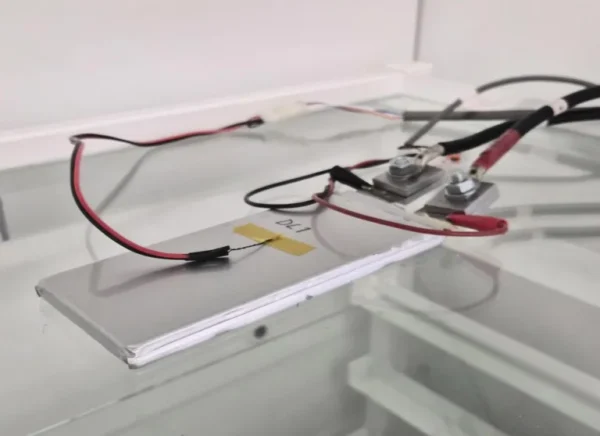
According to the report, the tested cell retained 97.7% of its charged capacity after sitting idle for 10 days at room temperature. During the test, VTT charged the battery to roughly 50% state of charge and left it unused for 240 hours. Afterward, almost the entire stored capacity was recovered.
At first glance, the number appears promising, but the details reveal a more complex picture. Most of the voltage drop occurred immediately after charging — a normal phenomenon known as voltage relaxation rather than actual self-discharge. In fact, the voltage fell by about 60 mV within the first 10 seconds and 103 mV during the first hour. After roughly ten hours, however, the battery’s voltage stabilized, drifting only 12 mV over the remaining 230 hours.
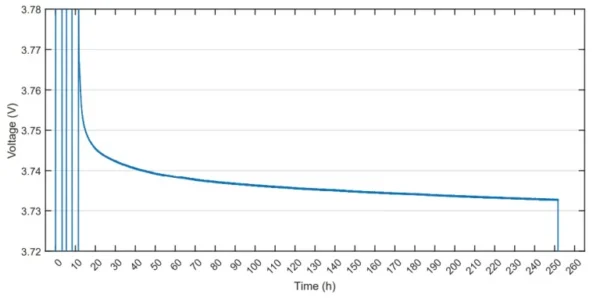
That relatively flat curve suggests the long-term self-discharge rate may be quite low, potentially comparable to or better than conventional lithium-ion batteries. Traditional Li-ion cells typically lose around 1–3% of charge per month once stabilized, though they often experience an initial drop shortly after charging. Because this test only lasted ten days, however, it is difficult to separate early relaxation effects from true long-term energy loss.
Interestingly, this is already the third verification report released by Donut Lab within a few weeks. Earlier tests confirmed two other key characteristics: extremely fast charging — reaching 80% capacity in about 4.5 minutes at an 11C rate — and stable discharge performance at temperatures as high as 100°C. Taken together, these results suggest the battery may indeed perform well in areas where solid-state chemistry theoretically offers advantages.
Yet the most controversial claims surrounding Donut Lab’s technology remain unverified. The company has previously suggested an energy density of 400 Wh/kg and an extraordinary 100,000-cycle lifespan, numbers that would dramatically exceed current industry benchmarks. Critics in the battery industry, including figures from companies like SVOLT Energy Technology, have questioned whether such specifications are physically achievable.
Crucially, the VTT reports do not include the battery’s weight or physical dimensions — data required to independently calculate energy density. Without that information, verifying the 400 Wh/kg claim remains impossible.
Final perspective: Donut Lab deserves credit for releasing independent test results more frequently and transparently than many battery startups. However, the company is still proving the specifications that engineers already consider achievable. The truly revolutionary claims — ultra-high energy density and unprecedented cycle life — remain unanswered. Until independent testing confirms those figures, the technology remains promising, but not yet transformative.