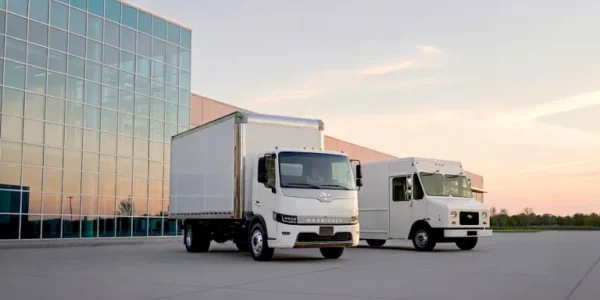
The push toward electrification in commercial vehicles is accelerating, and Harbinger has just introduced a new contender aimed directly at the medium-duty work truck segment. Revealed during Work Truck Week 2026, the new Harbinger HC Series Cab represents a major expansion of the company’s platform lineup.
Designed as a flexible box-truck chassis, the HC Series Cab is available in both fully electric (BEV) and extended-range electric (EREV) configurations with a gross vehicle weight rating of up to 26,000 pounds. That positions it squarely within a segment dominated for decades by diesel-powered trucks used for urban delivery, utility services, and construction support.
One of the most interesting aspects of the HC Series Cab is its design philosophy. Unlike traditional trucks that must accommodate bulky combustion engines, the electric architecture allows for a far more compact layout. This results in a low frame height of just 29 inches and a driver position that feels closer to a passenger car than a conventional work truck. Combined with a tight 42-foot turning circle, the truck is clearly designed with dense urban environments in mind — where maneuverability and visibility are often critical challenges for delivery fleets.
Harbinger has also focused heavily on total cost of ownership, an essential factor for fleet operators. The chassis uses a modular front-end structure that simplifies repairs and maintenance, potentially reducing downtime and service costs. The company also claims durability targets exceeding 450,000 miles, suggesting the platform is engineered for long service cycles typical of commercial fleets.
Powertrain flexibility is another key feature. While full specifications have not yet been released, the extended-range electric version is expected to use a 1.4-liter gasoline engine paired with an 800-volt generator system to recharge the battery during operation. This configuration could enable up to 500 miles of range under load, addressing one of the biggest concerns for electrified commercial vehicles: operational downtime due to charging.
Meanwhile, the fully electric version may use Harbinger’s modular battery architecture built from 35 kWh packs, potentially reaching around 210 kWh of total capacity. That setup would likely provide a range of roughly 200 miles, which is typically sufficient for many last-mile delivery routes.
Beyond propulsion, the truck also doubles as a mobile energy source. With up to 15 kW of exportable vehicle-to-load (V2L) power, operators can run tools or equipment directly from the truck — a feature that could prove especially valuable for construction or field service crews.
Final perspective: The HC Series Cab highlights how electric platforms can reshape the design and functionality of work trucks. If Harbinger can deliver on durability, range, and operating costs, the HC could become a compelling alternative to traditional diesel medium-duty trucks — especially in urban fleets where efficiency, maneuverability, and emissions reduction are increasingly important.