
Across the United States, a subtle but meaningful shift is underway in how local governments view small, low-speed vehicles. What was once limited to golf courses and private communities is increasingly becoming part of everyday transportation. More towns and cities are revising their regulations to allow golf carts to operate legally on public streets through simplified permits and local ordinances.
Technically, golf carts are not automatically street legal under federal regulations. To operate on public roads nationwide, vehicles must meet Low-Speed Vehicle (LSV) requirements established by the Federal Motor Vehicle Safety Standards (FMVSS). These rules require features such as headlights, brake lights, reflectors, seat belts, mirrors, and a top speed capped at about 25 mph (40 km/h). Some standards even include more modern safety technologies like pedestrian warning sounds and backup cameras.
In reality, however, many golf carts sold in the US do not fully meet these federal standards. Instead of redesigning the vehicles to meet LSV certification, some communities are choosing a different path: creating local regulations that allow golf carts on certain roads with simplified requirements.
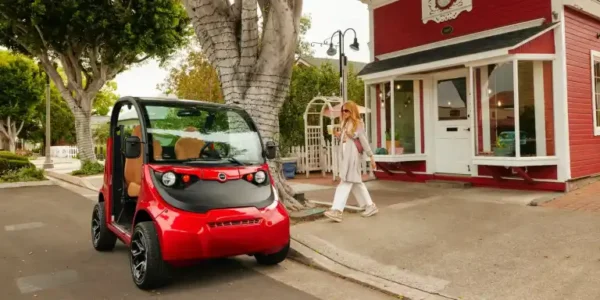
Several states have already adopted laws that give municipalities the flexibility to decide. In Michigan, for example, towns with populations under 30,000 can allow golf carts on local streets if local officials pass an ordinance. Other communities have created their own permit systems. Cities such as Wahoo, Nebraska require owners to obtain a city permit sticker before operating a golf cart on public roads, while Lake Saint Louis, Missouri allows them on streets with speed limits of up to 35 mph.
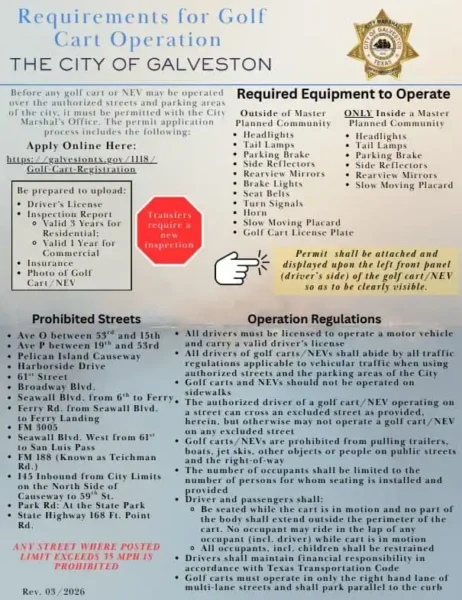
Tourist destinations and coastal towns have embraced the trend even more enthusiastically. In places like Galveston, Texas, golf carts can legally operate on roads with lower speed limits if they are registered with the city and display permit decals. These local systems typically require basic safety equipment like headlights, reflectors, seat belts, and slow-moving vehicle signs, even if they do not strictly enforce every federal LSV requirement.
The growing popularity of golf carts on public streets reflects their practicality in certain environments. In smaller communities, retirement neighborhoods, beach towns, and large suburban developments, distances are often short and traffic speeds are relatively low. For these kinds of trips — picking up groceries, taking kids to school, or visiting neighbors — a golf cart can function as a simple and efficient alternative to a full-sized car.
They also occupy an interesting middle ground between electric bicycles and conventional vehicles. Compared with an e-bike, a golf cart offers more seating, storage space, and protection from weather. Yet they remain far cheaper and easier to maintain than traditional cars, often costing only a fraction of the price while avoiding many registration and insurance requirements.
Final perspective: The growing acceptance of golf carts on public roads highlights how transportation is gradually becoming more diverse and flexible. While they are unlikely to replace conventional vehicles, golf carts may play an increasingly important role in short-distance mobility. For communities designed around slower speeds and local travel, these small electric vehicles could become a practical and surprisingly effective everyday transportation option.