Urban mobility is changing quickly, and manufacturers are increasingly focusing on safety and accessibility as cities grow more crowded. With the latest update to the Yamaha Tricity 300, Yamaha is pushing those ideas further by introducing new rider-assist technology and, most notably, an integrated airbag system.
This marks the first time Yamaha has fitted a production motorcycle with a built-in airbag, a move that signals how seriously the company is taking rider safety in everyday commuter machines.
A new approach to motorcycle safety
The airbag system was developed in partnership with Swedish safety specialist Autoliv, a firm best known for supplying airbags and safety systems to the automotive industry.
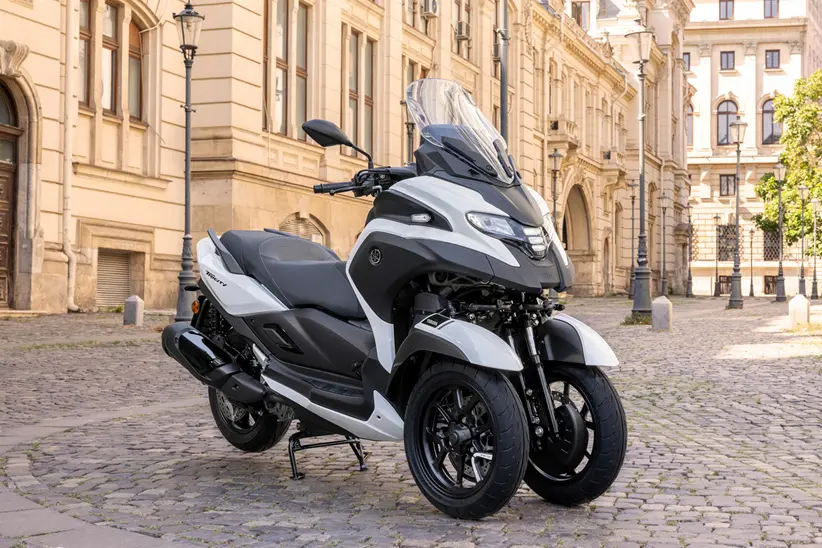
Just like a car airbag, the system uses sensors that detect a sudden deceleration consistent with a frontal collision. When triggered, the airbag deploys extremely quickly—faster than the blink of an eye—to cushion the rider and reduce the impact forces that could otherwise throw them over the handlebars.
Motorcycle airbags are not entirely new. Honda introduced an airbag system on the Honda Gold Wing back in 2006. However, the technology has largely remained limited to high-end touring bikes costing tens of thousands of pounds. By bringing it to a more affordable commuter scooter, Yamaha is effectively bringing advanced safety technology to a much wider group of riders.
Technology and rider aids
Beyond the airbag, the updated Tricity 300 gains several improvements in rider-assist technology. The addition of an inertial measurement unit (IMU) allows for lean-sensitive ABS, improving braking stability when cornering. This works together with Yamaha’s Unified Braking System, which distributes braking force automatically across the scooter’s three discs.
Traction control also remains standard equipment, helping maintain grip in slippery urban conditions.
The cockpit has been upgraded as well, now featuring a dual-screen dashboard that combines a 4.2-inch color TFT display with a 2.8-inch LCD screen. Riders can connect their smartphones through Yamaha’s MyRide app, giving access to calls, messages, and ride data. Navigation is also available through Garmin StreetCross, which can be mirrored directly onto the display.
Designed for urban practicality
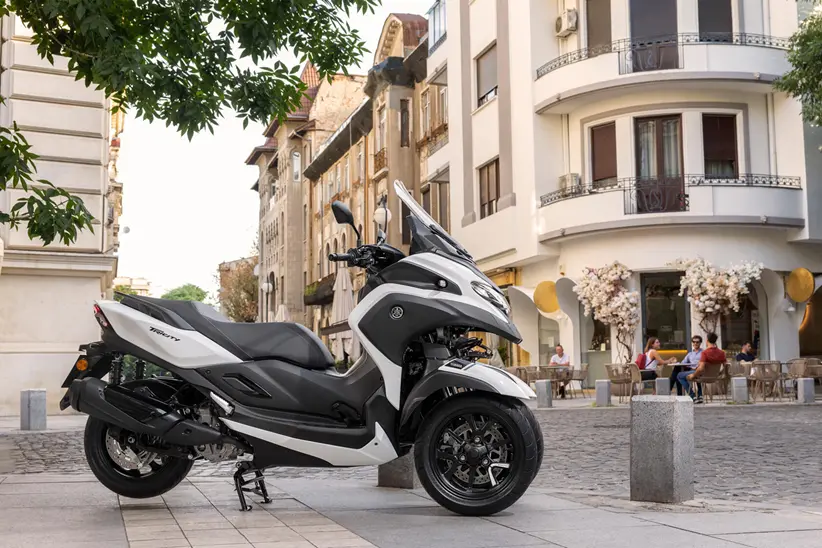
The Tricity 300 continues to use Yamaha’s 292cc Blue Core single-cylinder engine, paired with a CVT automatic transmission. While the engine itself remains unchanged, the exhaust system has been redesigned to meet Euro5+ emissions regulations and slightly reduce weight.
As expected from a city-focused scooter, practicality remains a strong point. The bike offers 45 litres of under-seat storage, enough for two full-face helmets, along with Smart Key ignition, a USB-C charging port, and a parking brake.
One of the Tricity’s most distinctive features is its standing assist system, which helps keep the scooter upright when stopped or maneuvering slowly in tight spaces. Combined with the three-wheel layout, this system makes the scooter easier to handle for new riders.
Accessible to more riders
Another reason the Tricity 300 stands out in the market is accessibility. In the UK, riders aged 21 or older can legally ride it with a standard car licence, making it appealing to commuters who may not want to obtain a full motorcycle licence.
With a price of around £8,780, the scooter sits in an interesting position between traditional two-wheel scooters and larger touring motorcycles.
Final perspective
The updated Yamaha Tricity 300 shows how motorcycle manufacturers are increasingly focusing on safety and accessibility, especially in the urban mobility segment. By introducing technologies like airbags and advanced electronic rider aids to a relatively affordable commuter scooter, Yamaha is helping push motorcycle safety closer to the standards long seen in cars.
If the concept proves successful, it could encourage more manufacturers to adopt similar systems in everyday motorcycles, potentially reshaping expectations for rider protection in the years ahead.