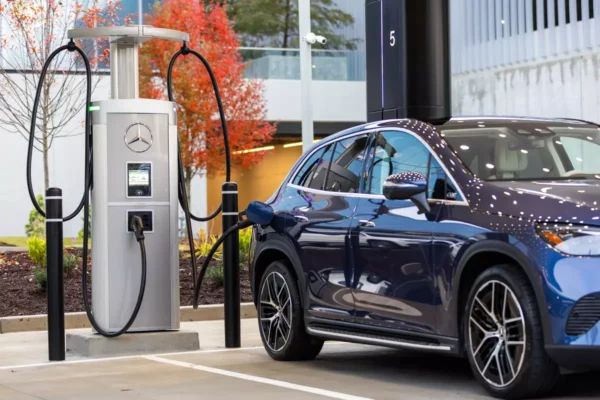
Mercedes-Benz has partnered with the coffee chain in an initiative that will install public DC fast-charging stations at 100 Starbucks locations along Interstate 5, which connects Canada to Mexico through Washington, Oregon and California.
The Mercedes effort will result in a denser charging environment, cramming 100 charging destinations into approximately the same distance, roughly 1,400 miles.
Mercedes and Starbucks say they “share an ambition to identify additional opportunities,” with the goal to expand to other critical travel corridors, key urban areas and charging deserts — areas with a shortage of convenient charging options.
The chargers themselves will be 400-kilowatt units, able to pump electrons into EV batteries as fast as the vehicle can accept them. The rate at which an EV can replenish its battery depends equally on the charging station and the vehicle’s onboard charger, as well as ambient temperature and other factors. At a 400-kW plug, some EVs can charge from 10% to 80% in less than 30 minutes, and many can add more than 150 miles of range in just 15 minutes.
Mercedes and Starbucks will supply the charging stations with 100% clean energy. Through its Ambition 2039 initiative, Mercedes is aiming to reach carbon neutrality across its entire vehicle fleet and supply chain by that year. This partnership is only the latest of the company’s many efforts to expand public fast-charging access. Along with five other automakers, Mercedes founded the Ionna network; now including Toyota, Ionna seeks to eventually install more than 30,000 chargers across the U.S. And as the sole automaker in a separate partnership with ChargePoint, Mercedes-Benz expects to have more than 2,500 chargers at some 400 “Charging Hubs” by 2027.