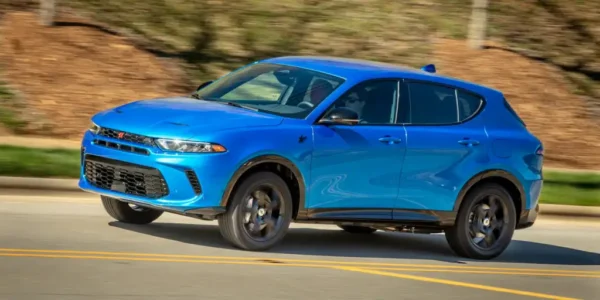
Stellantis has pulled another model from its U.S. lineup, and this time it’s Dodge’s most affordable vehicle. Following the earlier exit of the Jeep Wagoneer 4xe and Grand Cherokee 4xe plug-in hybrids, the Dodge Hornet is now officially out of production for the U.S. market.
The Hornet was built at Stellantis’ Pomigliano d’Arco plant in Italy alongside the Alfa Romeo Tonale, but that production line has now stopped supplying Dodge. A Dodge spokesperson confirmed to Car and Driver that “production of the Dodge Hornet, built in Italy, has ended,” citing “shifts in the policy environment”—a clear reference to the 25% tariffs on imported vehicles introduced under the Trump administration.
Why the Hornet was vulnerable
On paper, the Dodge Hornet seemed well-positioned. Starting at $31,990, it was Dodge’s cheapest vehicle and offered buyers a choice between a conventional gas engine and a plug-in hybrid (PHEV). But those same attributes also made it particularly exposed to policy changes.
Because the Hornet was built in Italy, the added tariffs squeezed margins on an already price-sensitive model. Unlike higher-end vehicles that can absorb cost increases, an entry-level crossover leaves little room for pricing flexibility—especially in a fiercely competitive segment.
At the same time, Stellantis has made a broader decision to withdraw all PHEVs from the U.S. market, including the Jeep Wrangler 4xe, America’s best-selling plug-in hybrid, as well as the Grand Cherokee 4xe and Chrysler Pacifica. The company says it will instead focus on “more competitive electrified solutions,” namely traditional hybrids and extended-range electric vehicles (EREVs).
What this means for U.S. consumers
For American buyers, the Hornet’s exit leaves a noticeable gap. Dodge customers looking for an affordable, compact crossover now have fewer options within the brand. More broadly, the move highlights how policy decisions can directly limit consumer choice, especially in the affordable electrified segment.
It also signals a shift in what buyers can realistically expect in the near term. Plug-in hybrids—once seen as a practical bridge to full electrification—are rapidly disappearing from some major lineups, replaced by hybrids or EREVs that prioritize range and cost stability over charging flexibility.
A wider industry pivot
Stellantis isn’t alone in changing course. Ford recently announced it would end production of the electric F-150 Lightning pickup, with plans to replace it with a next-generation EREV in 2027. Similarly, Ram has shelved the all-electric Ram 1500 REV in favor of an EREV version arriving later this year.
These moves suggest that automakers are recalibrating after an aggressive early EV push, responding to market demand, infrastructure realities, and policy uncertainty.
What’s still coming from Stellantis
Despite the pullback, Stellantis isn’t abandoning EVs entirely. One notable model still on the horizon is the Jeep Recon, Jeep’s first fully electric off-roader. Inspired by the Wrangler, the Recon promises serious trail credentials, removable doors, and performance figures aimed squarely at rivals like the Ford Bronco. It will join the Wagoneer S when it goes on sale this spring.
Final outlook: fewer choices, clearer priorities
From a consumer perspective, the loss of the Dodge Hornet is disappointing—not because it was revolutionary, but because it represented choice at a lower price point. Stellantis’ retreat reflects a harsher reality: electrification strategies are no longer just about technology, but about economics and policy survival.
The open question is whether this reset will ultimately benefit buyers through more viable, better-supported vehicles—or whether it will slow the transition by narrowing options just as affordability becomes the biggest barrier to adoption.