After a pause of roughly six months, Mercedes-Benz has quietly resumed U.S. orders for its EQ lineup of electric vehicles, just as the brand’s new electric CLA begins reaching American dealerships.
The move signals that Mercedes believes market turbulence has eased enough to re-engage U.S. buyers—though the reasons behind the original pause, and its timing, still raise questions from a consumer perspective.
Why Mercedes paused EV orders in the first place
Back in July, Mercedes abruptly stopped taking new U.S. EQ orders, citing vague “market conditions.” At the time, the decision appeared puzzling. U.S. EV sales were actually accelerating, heading into what would become a record quarter as buyers rushed to purchase vehicles before policy changes effectively raised EV prices by $7,500 through the loss of federal tax credits.
In hindsight, Mercedes may have been looking further ahead. Chaotic tariff policy, shifting incentives, and political uncertainty were about to disrupt not just EVs, but the broader U.S. auto market. And because most Mercedes buyers don’t qualify for the federal EV tax credit anyway—except through leasing—the brand had less incentive to chase short-term EV demand spikes.
Now, with that disruption largely priced in, Mercedes appears confident enough to restart orders.
EQ models are back—quietly
New 2026 model-year Mercedes EQ vehicles have already begun appearing at U.S. dealerships, suggesting the pause has effectively ended. Mercedes confirmed the strategy in a carefully worded statement, noting that it “temporarily adjusted U.S. EQ order availability” to align with demand and that it continues to optimize its production network.
In practical terms, this means U.S. buyers can once again order:
EQE Sedan
EQE SUV
EQS Sedan
EQS SUV
All of these models are built in Alabama, where Mercedes continued production during the pause—primarily for export markets.
What’s new for consumers in 2026
From a buyer’s standpoint, the timing may actually be favorable. The 2026 EQ lineup brings meaningful updates, not just cosmetic refreshes.
More power and quicker acceleration for EQE models
Standard NACS adapters across the EQ lineup, enabling access to Tesla’s Supercharger network
Incremental refinements that address earlier criticism around performance and charging convenience
For consumers who hesitated last year, these updates directly improve everyday usability.
The electric CLA changes the conversation
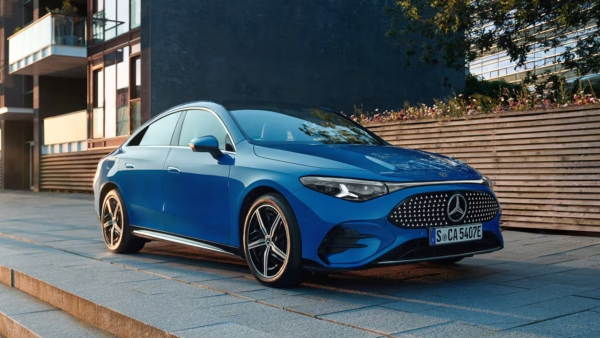
Alongside the EQ refresh, Mercedes is launching what may be its most important EV for the U.S. market so far: the electric CLA.
Already selling well overseas, the CLA EV is just starting to reach U.S. roads, with deliveries expected to scale through the current quarter. Unlike the larger EQ models, the CLA targets:
A lower price bracket
Younger, urban buyers
Customers entering the Mercedes brand for the first time
This matters because affordability—more than range or luxury—has become the key barrier for many EV shoppers.
From the consumer’s perspective
For U.S. buyers, Mercedes’ return to EV orders sends mixed but ultimately encouraging signals:
Positives
EQ models are back with tangible improvements
Charging access is dramatically better with Tesla Supercharger compatibility
The CLA EV offers a more attainable entry point into Mercedes EV ownership
Lingering concerns
The pause may reinforce perceptions that Mercedes’ EV strategy is cautious, even hesitant
Pricing remains a challenge compared to newer EV-focused brands
Final outlook: cautious confidence, not a full EV pivot
Mercedes’ decision to resume EQ orders isn’t a bold EV bet—it’s a measured re-entry. Rather than chasing every surge in EV demand, the brand is prioritizing stability, margins, and long-term positioning.
For consumers, that means Mercedes EVs are unlikely to be the cheapest or most aggressive on the market. But for buyers who value refinement, brand trust, and now—finally—better charging access, the EQ lineup’s return feels less like a comeback and more like a quiet reset.
The arrival of the electric CLA may ultimately matter more than the EQ pause itself. If it succeeds in the U.S., it could signal that Mercedes’ EV future isn’t about retreat—but about choosing its battles more carefully.