Tesla has quietly taken a small but telling step with its most elusive vehicle. Two new trademark filings for the Roadster, submitted to the United States Patent and Trademark Office on February 3, hint at how Tesla plans to present the electric supercar that’s been “coming next year” since 2017.
The first filing covers a stretched, angular ROADSTER wordmark—sharp, segmented, and clearly aimed at a high-performance image. The second is more intriguing: a minimalist silhouette made from three flowing curved lines, forming what appears to be the Roadster’s updated profile. It’s not a full reveal, but it’s the clearest official hint yet that the design is still alive.
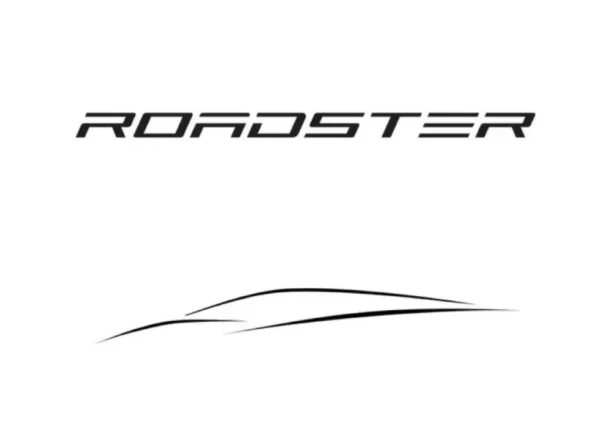
Both trademarks were filed on an “intent to use” basis, a standard move to secure naming and design rights ahead of a public launch. As trademark attorney Josh Gerben has noted, this locks in priority and keeps copycats at bay—something Tesla hasn’t always managed well in the past.
Context matters here. Elon Musk unveiled the next-gen Roadster in 2017 with promises of 2020 production. Since then, timelines have slipped repeatedly: 2022, 2023, 2024—each came and went. The latest plan puts a demo on April 1, 2026, with production penciled in for 2027 or 2028, a date Musk himself jokes about by invoking April Fools’ Day.
Then there’s the mythology: claims of a “SpaceX package,” cold-gas thrusters, and even the idea that the Roadster might “fly.” Musk has gone so far as to say that if safety is your top priority, this isn’t the car for you—framing it as the ultimate, unrestrained, human-driven machine.
Final take: These trademarks don’t mean the Roadster is imminent—but they do suggest Tesla is still invested in the story. Whether that story ends with a production car or remains a legend of specs and promises will determine if the Roadster becomes a triumph—or the most famous never-was in EV history.