Tesla has discreetly refreshed its official Semi website—and with it, confirmed the final production specifications for its long-awaited Class 8 electric truck. Two trims are now listed, Standard Range and Long Range, signaling that customer deliveries are no longer theoretical as Tesla prepares for volume production in early 2026.
The numbers matter. The Standard Range Semi offers 325 miles at a full 82,000-lb gross combination weight, while keeping curb weight under 20,000 lbs. The Long Range stretches that to 500 miles, supported by what is effectively a ~900 kWh battery pack, based on Tesla’s long-stated 1.7 kWh/mile efficiency. Both variants use three independent rear motors, deliver 800 kW of drive power, and support MCS 3.2 megawatt charging, enabling a 60% recharge in just 30 minutes—perfectly aligned with mandated driver rest breaks.
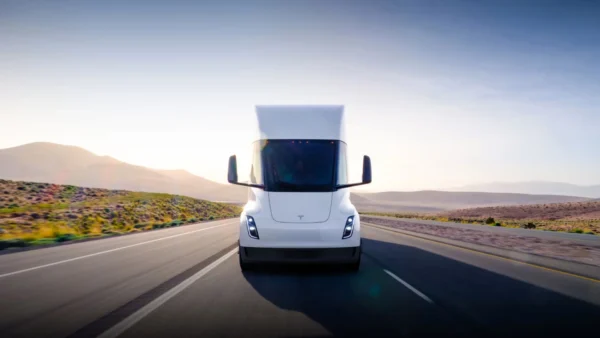
Compared with diesel trucks, the Semi’s appeal isn’t just emissions. It’s predictability: fewer moving parts, lower energy cost per mile, and the ability to recharge during downtime instead of idling. Against rivals like Freightliner’s eCascadia or Volvo’s electric VNR, Tesla’s advantage is efficiency and charging speed. Few competitors are yet ready for 1.2 MW peak charging, which could translate into hundreds of miles added during a single stop.
Tesla also slipped in an important line: both variants are “designed for autonomy.” That hints at a future where the Semi becomes part of Tesla’s autonomous freight vision—something the company previously avoided stating outright for its truck.
Is it right for different markets?
United States: Absolutely. Long interstate routes, centralized depots, and growing megawatt charging corridors make the Semi a strong fit.
Canada: Viable for regional and corridor freight, especially with cold-weather advantages of electric drivetrains.
Australia: More challenging. Long distances and sparse charging infrastructure limit immediate appeal, but mining, ports, and fixed routes could be ideal use cases.
Pricing remains the unanswered question. Tesla originally promised $150,000–$180,000 pricing back in 2017, but updated figures are still missing. Even so, if operating costs deliver as promised, total cost of ownership could still undercut diesel.
Final take: The Tesla Semi is no longer a moonshot—it’s shaping up as a serious commercial tool. If Tesla executes on production and charging infrastructure, this truck could quietly become one of the most disruptive products the company has ever built.