
When BYD announced that its luxury sub-brand Denza would bring the Denza Z9 GT to Europe, it wasn’t just another product launch. On paper, this car promises something the EV industry has been chasing for years: ultra-fast charging combined with long driving range.
And if the numbers hold up, this could be one of the most disruptive EVs entering the European market.
Big Claims: Range and Charging That Redefine Expectations
The headline figures are hard to ignore. In China’s CTLC cycle, the Z9 GT is rated at over 1,000 km of range. More realistically, under the stricter WLTP standard used in Europe, it delivers up to around 800 km.
That alone already places it among the longest-range electric vehicles available today.
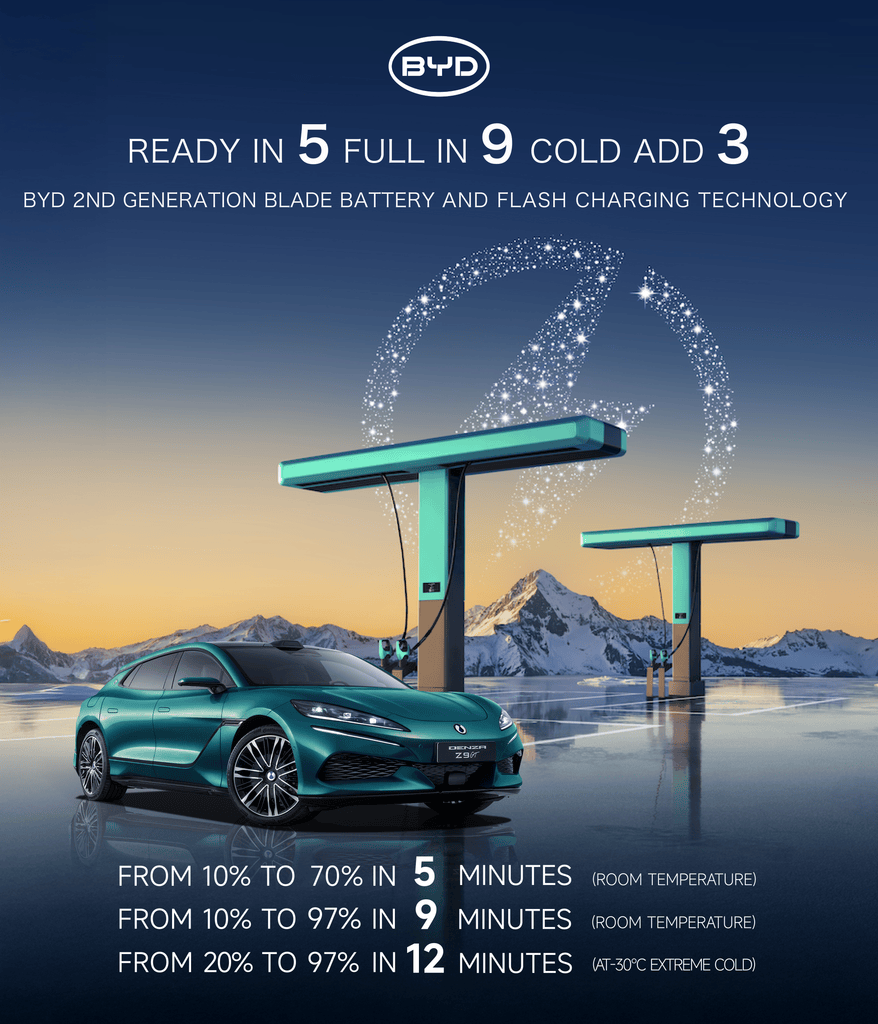
But what really stands out is the charging capability. BYD claims its new Flash Charging system can push the battery from 10% to 70% in just five minutes, and nearly full in under ten. The system supports charging power up to 1,500 kW, which is far beyond what most current EV infrastructure can deliver.
From a technical perspective, this is where things get interesting. The Z9 GT uses a large 122 kWh Blade Battery, a lithium iron phosphate (LFP) chemistry known for safety and durability. Traditionally, LFP batteries lag behind in energy density and charging speed compared to other chemistries, but BYD appears to be pushing those limits.
If this charging performance works consistently outside controlled conditions, it could fundamentally change how people think about EV charging.
Performance and Size: Competing with European Luxury EVs
In terms of size, the Z9 GT sits firmly in the premium segment, comparable to models like the Porsche Taycan or Porsche Panamera.
The performance figures reinforce that positioning. The rear-wheel-drive version already delivers close to 500 horsepower, while the tri-motor setup pushes output beyond 1,100 horsepower. That’s enough for a 0–100 km/h time under three seconds, putting it in supercar territory.
From a driving perspective, this combination of high power and large battery suggests the Z9 GT is not just about efficiency, but also about delivering a premium, high-performance experience.
Interior and Experience: Targeting the Luxury Buyer
BYD is clearly aiming beyond just specs. The Z9 GT’s interior focuses heavily on experience, with a high-end audio system and Dolby Atmos integration designed to create what the company calls an “opera-house” environment.
That might sound like marketing language, but it reflects a broader trend in EV design. As powertrains become more standardized, automakers are differentiating through software, entertainment, and cabin experience.
The choice of launching the car at a venue like the Paris Opera House reinforces that positioning. This is not just a car — it’s meant to be a statement product.
The Real Question: Infrastructure and Real-World Use
While the specifications are impressive, there’s a practical limitation that can’t be ignored.
The 5-minute charging claim depends on access to BYD’s Flash Charging stations, which are currently concentrated in China. Although BYD plans to roll out this infrastructure in Europe, it will take time before it reaches meaningful coverage.
Without that network, the Z9 GT will rely on existing charging infrastructure, where speeds are significantly lower. In that scenario, the real-world advantage becomes less dramatic.
This is a familiar pattern in the EV industry. Hardware capabilities often move faster than infrastructure.
Pricing: A Potential Disruptor
In China, the Z9 GT starts at around $39,000, which is extremely competitive for a vehicle of this size and performance.
However, pricing in Europe will almost certainly be higher due to taxes, logistics, and positioning as a premium product. Even so, if BYD manages to undercut traditional luxury brands, it could put serious pressure on established players.
Personal Perspective
What stands out to me is how aggressively BYD is pushing both range and charging at the same time. Most automakers tend to prioritize one or the other. Here, the company is trying to solve both problems simultaneously.
That’s ambitious — and potentially risky.
If the charging experience works as advertised, this could be a genuine leap forward. If not, it risks being seen as another case of impressive specs that don’t fully translate into everyday use.
Final Verdict
The Denza Z9 GT is one of the most technically ambitious electric vehicles entering Europe. With long range, ultra-fast charging, and strong performance, it has the potential to challenge established luxury EVs.
However, its biggest advantage — the 5-minute charging — depends heavily on infrastructure that is not yet widely available outside China.
Clear opinion:
This is a bold and promising product, but its real impact will depend on how quickly BYD can build out its charging ecosystem in Europe. Without that, the Z9 GT is still competitive — just not revolutionary.


