Kia is doubling down on electric SUVs as it maps out its next phase of growth. After a record-breaking first quarter, the automaker laid out an ambitious plan to scale global sales to 4.13 million vehicles by 2030—up from just over 3.1 million last year—driven largely by electrification, software, and next-generation vehicle platforms.
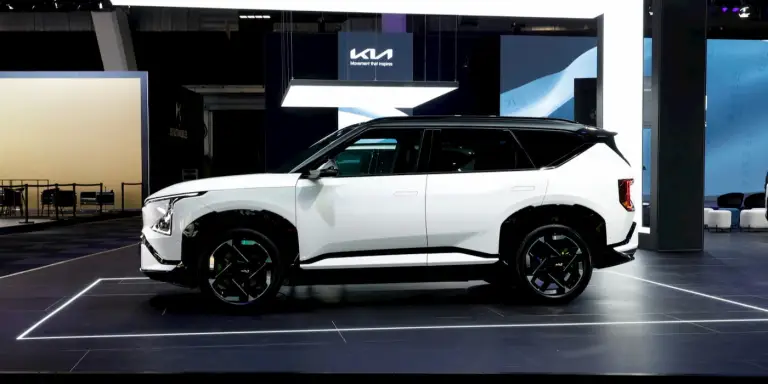
At the center of that strategy is the growing success of the Kia EV5, a midsize electric SUV that’s quickly becoming one of Kia’s most important global models.
EV5: The Blueprint for Kia’s Next Growth Phase
The EV5 sits in one of the most competitive segments globally—roughly the same size as the Sportage—and that’s exactly why it matters. It targets mainstream buyers rather than early adopters, offering a balance of size, practicality, and price.
After launching in China in 2023, the EV5 helped Kia regain momentum in a critical market. Its rollout has since expanded to Europe, Canada, Australia, and South Korea, where demand is building steadily.
In Australia, for example, it already ranks among the top 10 EVs, competing directly with models like the BYD Atto 3. In Canada, Kia expects it to become its best-selling vehicle across both electric and combustion lineups.
That’s a strong signal: EV adoption is moving into the mainstream.
A New Electric SUV to Scale Even Further
Building on that momentum, Kia is developing a new C-segment electric SUV, scheduled to arrive in 2029. The company expects it to sell around 85,000 units annually by 2030—more than double the projected sales of the EV5.
This next model will sit in the same high-volume category but is designed to push efficiency and performance further. It will be based on Kia’s next-generation EV platform, which promises:
- Up to 40% more battery capacity
- Around 9% higher motor output
- 15% improvement in energy density
In simple terms, that means longer range, better performance, and potentially lower cost per kilometer—key factors for mass-market adoption.
Beyond Hardware: Software and Autonomy
Kia’s roadmap goes beyond batteries and motors. The company is shifting toward software-defined vehicles (SDVs), with its first model expected by 2027.
Future EVs will feature a new infotainment system, improved connectivity, and Level 2++ driver assistance—essentially more capable highway automation that still requires driver supervision.
Under the hood, Kia plans to use Hyundai’s CODA architecture alongside new AI-driven systems, aiming to make vehicles more adaptable and updatable over time.
This reflects a broader industry shift: cars are increasingly becoming software platforms, not just hardware products.
Pros and Cons of Kia’s Strategy
Pros:
- Strong focus on high-demand SUV segments
- Clear scaling strategy from EV5 to next-gen models
- Improved battery efficiency and performance
- Investment in software and future-ready tech
Cons:
- New flagship EV won’t arrive until 2029
- Heavy reliance on future platform promises
- Increasing competition from lower-cost Chinese EV makers
- Execution risk in software-defined vehicle transition
How It Compares
Kia’s approach mirrors what many global automakers are doing—expanding EV lineups while investing in software—but with a sharper focus on volume segments.
Compared to premium-focused players, Kia is targeting affordability and scale. At the same time, it faces growing pressure from companies like BYD, which are moving quickly with lower-cost EVs and vertically integrated supply chains.
The EV5’s early success suggests Kia can compete—but sustaining that momentum will depend on how quickly it can deliver its next-generation models.
Final Verdict
Kia’s strategy is clear: win the EV transition by focusing on the segments that matter most.
The EV5 shows that approach can work. But the real test will come with its next-generation SUV in 2029, where improvements in battery technology, software, and cost efficiency will need to translate into real-world value.
If Kia executes well, it won’t just keep up in the EV race—it could help define the mass market.