For Subaru, the start of production of the new Trailseeker at the Gunma Yajima Plant marks more than just another model launch. It’s the first time an electric vehicle has rolled off the line at this historic factory—and a clear signal that Subaru is finally taking direct ownership of its EV future.
Known as the e-Outback in parts of Europe, the Trailseeker is Subaru’s second global electric SUV after the Solterra. But unlike the Solterra, which is built at a Toyota-owned facility, this one is produced in-house in Japan. Yes, Toyota still plays a role through co-development and the modified e-TNGA platform, but the manufacturing shift matters. It gives Subaru tighter control over quality, scaling, and long-term EV strategy.
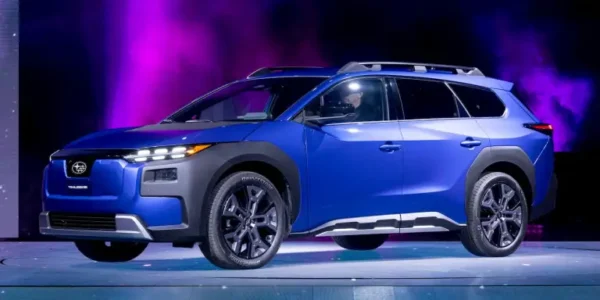
Positionally, the Trailseeker sits in a sweet spot. It’s larger and more powerful than the Solterra, closer in footprint to rugged midsize EVs like the Toyota bZ Woodland, while leaning harder into Subaru’s outdoors-first identity. With 375 horsepower, standard Symmetrical AWD, a 0–60 mph time of 4.4 seconds, and 3,500 lbs of towing, it comfortably outguns many compact electric SUVs that prioritize efficiency over capability.
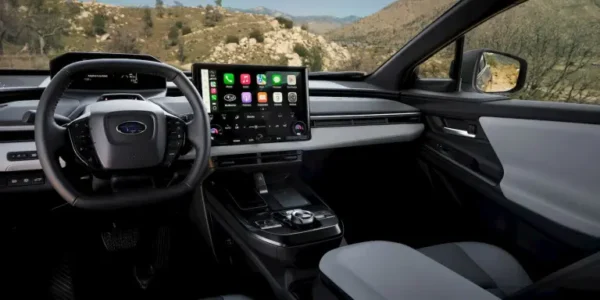
Compared to rivals like the Tesla Model Y or Hyundai IONIQ 5, the Trailseeker isn’t chasing minimalism or ultra-fast charging. Its appeal is versatility: more cargo space, real roof-load capacity, trail-ready AWD tuning, and native access to Tesla’s Supercharger network via NACS. A 280-mile range and 150 kW charging are competitive, if not class-leading—but sufficient for its mission.
Final take: The Trailseeker feels like Subaru’s first EV designed to be unapologetically Subaru. It may not redefine the segment on paper, but by combining in-house production with genuine utility and brand coherence, it shows Subaru is no longer just experimenting with electric vehicles—it’s committing to them.