At MWC Barcelona, Xiaomi unveiled the full technical details of its striking Xiaomi Vision Gran Turismo — and the concept is far more than a simple styling exercise. Packed with unusual engineering ideas, from magnetic wheel systems to airflow-controlled bodywork, the car represents Xiaomi’s ambition to prove it can compete in the world of high-performance automotive innovation.
Although the Vision GT will never enter mass production, it offers a glimpse into the design philosophy and engineering capabilities Xiaomi wants to showcase as it prepares to expand its EV business globally.
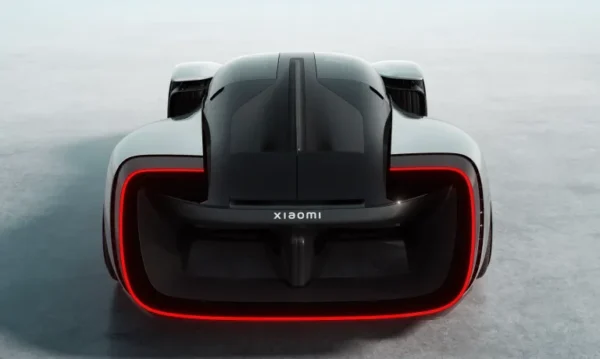
One of the most remarkable aspects of the concept is its aerodynamic approach. Xiaomi claims the car achieves a drag coefficient of just 0.29 while still producing significant downforce, with an aerodynamic efficiency rating of 4.1. In the hypercar world, balancing low drag with strong downforce is notoriously difficult. Vehicles optimized for top speed typically sacrifice cornering grip, while track-focused designs often create heavy drag. Xiaomi’s designers aimed to solve this by shaping every element of the body to manage airflow naturally rather than relying on large wings or spoilers.
The car’s silhouette reflects that philosophy. The cockpit follows a teardrop profile — one of the most efficient shapes in aerodynamics — while the body channels air through sculpted passages that guide airflow from the front to the rear. Massive outlets integrated into the halo-shaped taillight help manage the turbulent wake behind the vehicle.
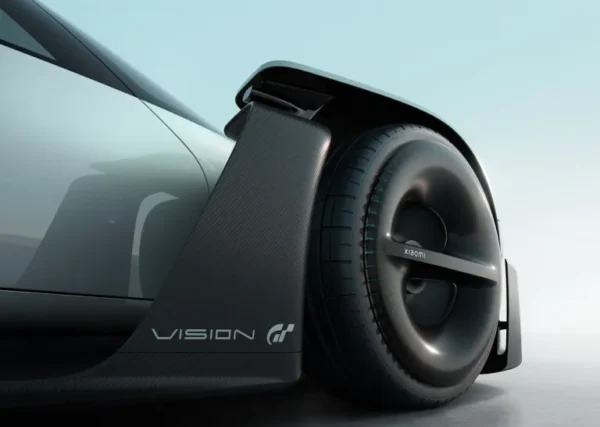
Perhaps the most technically intriguing innovation is the “Accretion Rim” system. These vortex-shaped wheel covers remain stationary even as the wheels spin underneath them, thanks to a magnetic mechanism. Rotating wheels typically generate significant aerodynamic drag, but by keeping the covers fixed relative to the airflow, Xiaomi claims the system reduces resistance while simultaneously creating a dramatic floating visual effect. Inside the semi-transparent covers, turbine-like fins also draw air through the wheels to help cool the brakes.
At the rear, Xiaomi replaces a traditional active spoiler with what it calls an “Active Wake Control System.” Instead of large moving surfaces, the car uses a series of micro-perforations around the taillight that manipulate airflow in real time. By controlling turbulence behind the vehicle, the system aims to improve both efficiency and stability while maintaining the car’s smooth exterior surfaces.
Inside the cabin, Xiaomi departs from the typical hypercar formula. Instead of rigid racing-style bucket seats, the company introduces what it calls the “Sofa Racer” concept. The cockpit forms a continuous ring-like structure where the seats, dashboard, and door panels merge into one flowing design. Materials are inspired by the sports fashion industry, using 3D-knitted fabrics to create a softer, more comfortable environment.
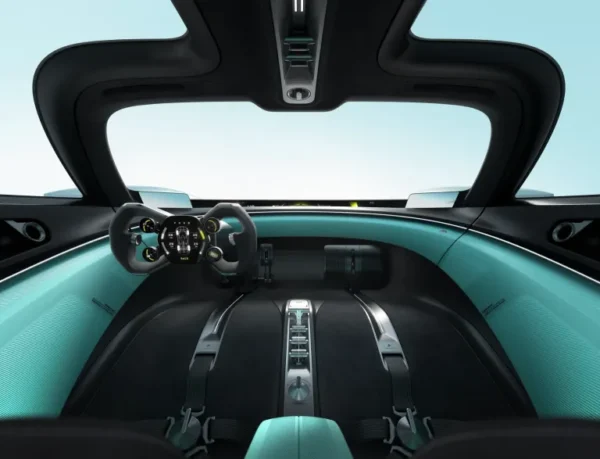
Technology also plays a central role. Xiaomi Pulse, a 360-degree digital assistant embedded in the dashboard, monitors the driver and surroundings, while Xiaomi HyperVision adapts the interface depending on the driving scenario — offering minimal telemetry for track driving or immersive navigation for long journeys.
The project has already attracted attention from the gaming world. Kazunori Yamauchi, the legendary producer of the Gran Turismo franchise, praised the concept’s aerodynamic balance. The Vision GT will eventually become playable in Gran Turismo 7, making Xiaomi the first technology company to participate in the Vision Gran Turismo program alongside traditional automakers such as Ferrari, Porsche, and Lamborghini.
In reality, the Vision GT is less about building a hypercar and more about shaping perception. Xiaomi plans to begin overseas expansion in 2027, targeting Europe with an expanding retail and R&D presence. By showcasing advanced design ideas and technological ambition, the concept serves as a powerful branding tool.
In my view, Xiaomi’s Vision Gran Turismo signals a deeper shift in the automotive industry. Technology companies are no longer content to supply software or electronics — they are stepping directly into vehicle design and engineering. Even if the Vision GT remains a virtual concept, it demonstrates that Xiaomi intends to be taken seriously not only as a tech brand, but as a future global automaker.