
Tesla has filed new plans with Travis County that outline a major expansion of its Giga Texas site in Austin — and the scope goes far beyond adding more factory space. The proposal combines two very different ambitions: a large public eco-park along the Colorado River and a massive new “North Campus” tied to an advanced semiconductor project.
Together, they signal Tesla is thinking bigger about its Austin footprint, but also raise questions about execution, timelines, and priorities.
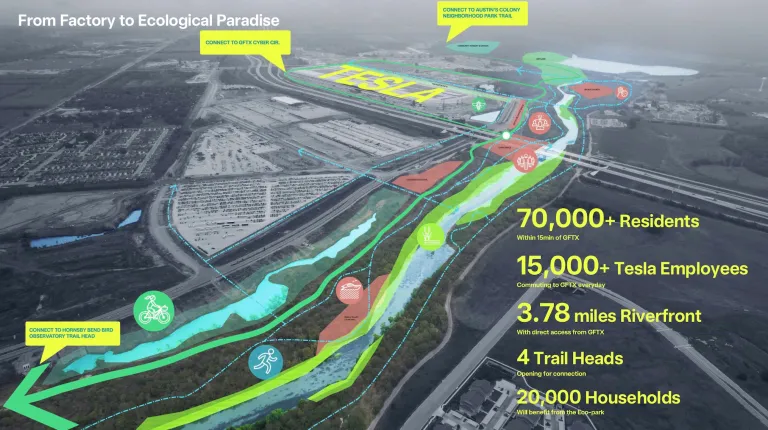
The Eco-Park: Big Vision, Slow Progress
At the center of the plan is the long-promised riverfront eco-park, first mentioned by Elon Musk back in 2020.
According to updated filings, the project includes:
- 25 miles of walking trails
- 18 miles of biking paths
- Nearly 4 miles of river access
- 290 acres of preserved green space
- 53 wetland zones for flood mitigation
- Eight wildlife corridors
Tesla also plans to plant 3,000 trees annually and add community features like sports fields, a boardwalk, playgrounds, and a small orchard. The company estimates up to 20,000 households could benefit.
From a design perspective, it’s an ambitious urban green project — something closer to a public park system than a typical corporate campus add-on.
However, the reality is more complicated. The concept has been discussed for years with limited visible progress. A smaller pilot area was introduced in 2023, but large-scale development has yet to materialize.
There is also a regulatory angle. Tesla has taken advantage of new Texas legislation to bypass certain local environmental rules, which may speed up development but has raised concerns about oversight.
North Campus and Terafab: A Much Bigger Bet
The second part of the expansion is arguably more significant.
Tesla is planning to add over 5.2 million square feet of new facilities, starting with a 2-million-square-foot R&D building. This expansion is tied to the newly announced Terafab project, a joint initiative involving Tesla, SpaceX, and xAI.
The goal: build a next-generation semiconductor manufacturing facility in Austin.
Key targets include:
- 2-nanometer chip production by 2027
- Initial capacity of 100,000 wafers per month
- Long-term goal of 1 million wafers per month
If achieved, this would place Tesla among the most advanced chip manufacturers in the world — competing with established players in an extremely complex industry.
Technical Reality Check: Ambitious, but Risky
From a technical standpoint, the Terafab project is the most challenging part of Tesla’s plan.
Semiconductor manufacturing at 2nm scale requires:
- EUV lithography systems (currently supply-constrained)
- Ultra-clean fabrication environments
- Decades of process expertise
Tesla currently has no direct experience in chip fabrication at this scale. While it has strong in-house chip design capabilities, manufacturing is a very different challenge.
There are also supply chain constraints. EUV machines are reportedly backlogged through 2027, which could impact timelines.
What This Means for Tesla’s Strategy
This expansion reflects a broader shift in Tesla’s approach:
- Moving beyond vehicles into infrastructure and manufacturing ecosystems
- Investing in vertical integration, including chips
- Expanding its physical footprint in key regions
At the same time, it introduces complexity. Tesla is now balancing:
- Automotive production
- AI and software development
- Semiconductor manufacturing
- Public infrastructure projects
That’s a wide range of priorities for any company, even one with Tesla’s resources.
On-the-Ground Progress
Construction activity has already begun in the northern section of the site, including:
- Land clearing
- Soil preparation
- Early-stage infrastructure work
Tesla has also posted job listings related to Terafab, indicating the project is moving beyond the planning phase.
Final Verdict: Visionary Expansion with Execution Risk
Tesla’s latest Giga Texas plans are undeniably ambitious. The combination of a large-scale eco-park and a cutting-edge semiconductor facility reflects a company aiming to expand far beyond its original scope.
However, ambition alone is not enough.
Clear opinion:
The eco-park is a compelling idea but overdue on execution, while the Terafab project represents a high-risk, high-reward bet in an industry where experience matters. If Tesla can deliver even part of what it’s proposing, the Austin campus could become one of the most advanced industrial sites in the world. But based on past timelines, it’s reasonable to expect delays — and to treat these plans as long-term goals rather than near-term realities.