
Rivian has officially opened the online configurator for the upcoming Rivian R2, giving reservation holders their clearest look yet at the electric SUV the company is counting on to transform its business.
And the details make one thing clear: Rivian is positioning the R2 directly against the Tesla Model Y.
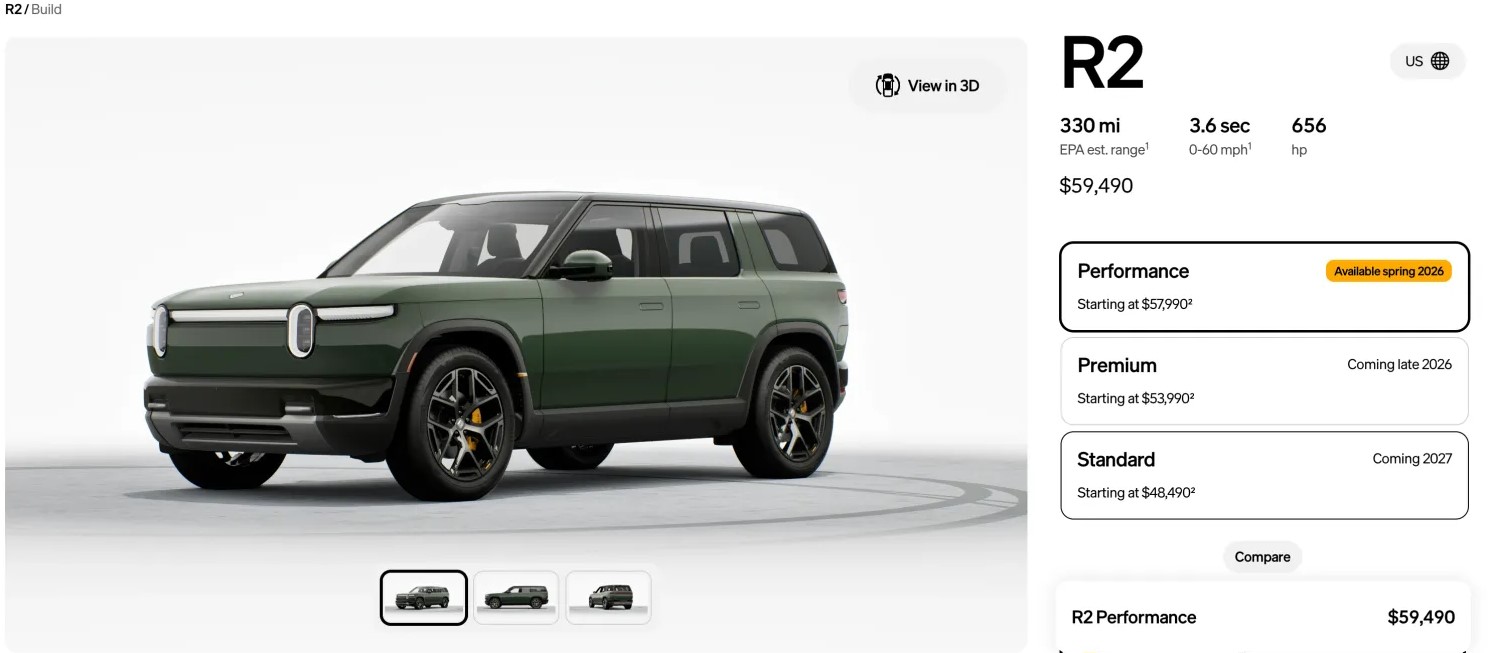
The first version available to configure is the R2 Performance, priced at $57,990 with an estimated 330 miles of EPA range, 656 horsepower, and a 0–60 mph time of 3.6 seconds. That places it just below the refreshed Model Y Performance, which currently starts at around $58,880 in the US.
The price difference is relatively small, but strategically important.
For years, Rivian’s R1T and R1S established the company as a premium EV brand with strong design identity and off-road credibility. The problem was scale. Those vehicles were simply too expensive to compete in the higher-volume sections of the EV market where companies like Tesla dominate.
The R2 is designed to change that.
More compact, less expensive, and aimed squarely at the midsize crossover segment, the R2 represents Rivian’s first true mass-market vehicle. In many ways, it is the company’s equivalent of what the Model 3 and Model Y were for Tesla: the product intended to move Rivian from niche manufacturer to mainstream automaker.
The configurator also reveals how carefully Rivian is managing that transition.
At launch, only the highest-margin Performance trim is available to order. Rivian says the lower-priced Premium trim will follow in late 2026, while the entry-level Standard version will not arrive until 2027. That staggered rollout mirrors Tesla’s long-standing strategy of launching expensive trims first to maximize profitability during early production ramps.
Given Rivian’s financial situation, that approach is not surprising.
The company still loses money on every vehicle it sells, and the R2 is widely viewed as its most important path toward sustainable margins. Launching with higher-priced configurations helps Rivian generate more revenue per vehicle while scaling manufacturing at its Illinois plant.
From a product perspective, the R2 feels intentionally positioned between rugged lifestyle SUV and mainstream family EV.
The design retains Rivian’s signature styling cues, including the vertical headlights and minimalist interior layout, but in a smaller and more approachable package than the larger R1S. Buyers can choose from multiple exterior colors, wheel designs, and interior themes, with optional all-terrain wheels and accessories reinforcing Rivian’s outdoors-focused branding.
There are also practical touches that stand out.
The optional compact spare tire, for example, may seem minor, but it reflects Rivian’s understanding of its target audience. Unlike many EV crossovers designed primarily for urban commuting, the R2 is clearly being marketed toward buyers who may actually leave paved roads occasionally.
That positioning differentiates it from Tesla.
While the Model Y remains one of the most efficient and technologically mature EVs on the market, Rivian appears to be leaning more heavily into lifestyle appeal, interior flexibility, and adventure-oriented design. The R2 likely will not match Tesla’s software ecosystem or charging network integration immediately, but it may resonate more strongly with buyers looking for something less minimalist and more personality-driven.
The challenge, however, will still be pricing.
At $57,990, the Performance trim competes directly with premium EV territory rather than the mainstream market Rivian ultimately needs to capture. Even the future $48,490 Standard model remains notably more expensive than Tesla’s base Model Y, which starts closer to the low-$40,000 range after recent pricing adjustments.
That gap matters, especially as EV competition intensifies globally.
Rivian is effectively betting that buyers will pay more for distinctive design, utility, and brand identity. Whether that premium positioning works at scale remains one of the biggest open questions surrounding the company’s future.
Still, the R2 appears to address many of the concerns that limited Rivian’s earlier vehicles. It is smaller, more attainable, and better aligned with the largest segment of the modern EV market. And unlike many startups chasing futuristic concepts, Rivian now appears focused on execution, manufacturing discipline, and platform scalability.
CEO RJ Scaringe has already hinted that the R2 architecture will support additional future models, helping Rivian spread development costs across a broader lineup over time.
That may ultimately matter more than the horsepower figures or acceleration times.
The R2 is not just another Rivian launch. It is the vehicle that will likely determine whether Rivian becomes a sustainable long-term automaker or remains a well-regarded niche EV brand. And based on what the configurator reveals so far, the company finally seems to have a product capable of competing in the market segment that matters most.


