
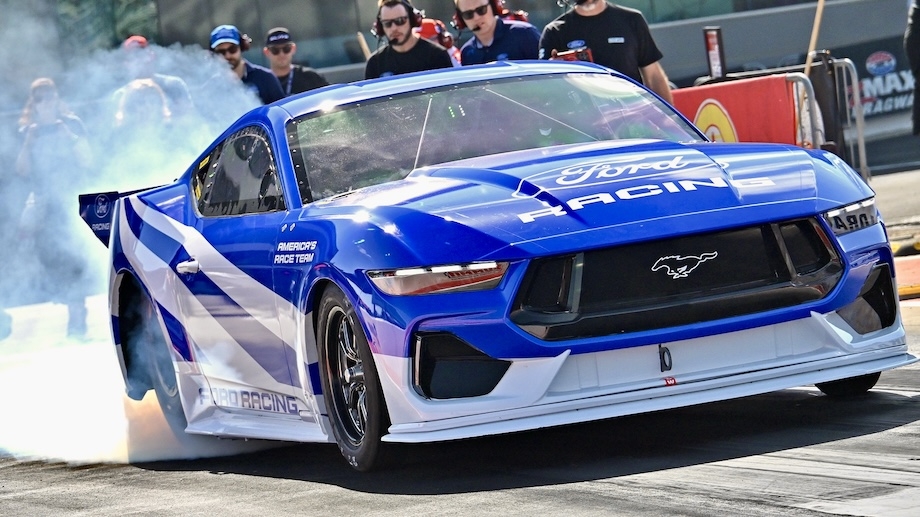
Ford has set a new benchmark for electric drag racing. Its latest prototype, the Ford Mustang Cobra Jet 2200, recorded a 6.87-second quarter-mile run at over 220 mph during the NHRA 4-Wide Nationals in Charlotte, making it the quickest electric car to date.
The run improves significantly on Ford’s previous record of 7.623 seconds, set by the Cobra Jet 1800 in late 2024. In a discipline where gains are often measured in thousandths of a second, a 0.75-second improvement is substantial.
A Ground-Up Redesign Focused on Efficiency
Unlike its predecessor, the Cobra Jet 2200 is not an incremental upgrade. Ford reworked the entire system to prioritize efficiency, weight reduction, and power delivery.
The car produces a combined 2,200 horsepower from two custom-built electric motors. Each motor is paired with a high-efficiency inverter exceeding 98% efficiency, helping convert electrical energy into usable power with minimal loss.
Notably, the new motors are significantly lighter—about half the weight of the previous generation—while delivering higher output. This reflects a broader trend in EV development, where improving power density is just as important as increasing raw power.
Simplified Architecture, Higher Output
Ford reduced the drivetrain complexity compared to the Cobra Jet 1800. The earlier model used four motors and four inverters, while the 2200 uses just two of each.
This simplification reduces overall mass and mechanical complexity while improving efficiency. The result is a more streamlined system that delivers better performance with fewer components.
The vehicle operates on a 900-volt architecture with a 32 kWh battery pack, allowing it to recharge in roughly 20 minutes—well within the NHRA’s typical 45-minute turnaround between runs.
Managing Torque in a High-Power EV
One of the more unconventional features is a centrifugal clutch, a component more commonly associated with internal combustion vehicles. In this case, it plays a key role in managing how torque is applied at launch.
Electric motors deliver instant torque, which can overwhelm traction. The clutch briefly slips at launch to smooth power delivery before locking into direct drive for maximum efficiency.
The car also uses a multi-speed transmission. While many EVs rely on single-speed setups, drag racing places unique demands on power delivery. According to Ford, the transmission helps keep the motors within their optimal performance range and can improve quarter-mile times by over a second compared to a single-speed configuration.
Battery Layout Designed for Traction
The Cobra Jet 2200 features a flexible battery layout, including an underfloor pack, rear-mounted packs, and an adjustable front battery position.
This allows engineers to fine-tune weight distribution for better traction—an essential factor in drag racing, where grip at launch largely determines performance.
Ford also introduced a pyrotechnic circuit breaker, a safety system designed to instantly disconnect the high-voltage battery in the event of an incident. The system uses a small explosive charge to physically sever the connection, aligning with NHRA safety requirements.
Rapid Progress in Electric Drag Racing
Ford’s electric drag racing program has advanced quickly over a short period. The Cobra Jet 1400 recorded an 8.128-second run in 2021. The Cobra Jet 1800 brought that down into the mid-7-second range in 2024.
Now, the Cobra Jet 2200 has broken into the 6-second range, with consistent runs reportedly between 6.86 and 6.87 seconds during testing.
This progression—more than a full second improvement in under five years—highlights the pace of development in electric performance systems.
Why It Matters
The Cobra Jet 2200 demonstrates how electric powertrains are evolving in specialized motorsport environments. Advances in efficiency, power density, and control systems are translating into measurable performance gains.
While these technologies are developed for racing, elements such as high-voltage architectures, improved inverters, and thermal management systems often influence future road-going EVs.
Takeaway
Ford’s latest record underscores the rapid progress of electric performance technology. The Cobra Jet 2200’s results show how engineering refinements—not just increased power—are driving the next phase of EV performance development.