
A Southern California trucking company is putting the Tesla Semi to work in one of the toughest real-world environments for freight: port drayage. MDB Transportation has launched a three-week pilot using the electric Class 8 truck on active routes serving the Ports of Los Angeles and Long Beach.
The test focuses on key operational metrics, including energy efficiency, trip cycles, and driver experience—factors that are critical for fleet operators considering a shift to electric trucks.
Why Port Drayage Is a Key Use Case
Drayage—short-haul container transport between ports, warehouses, and rail yards—is widely seen as one of the most practical starting points for electric trucking.
Routes are typically short and repetitive, with trucks returning to a central depot regularly. That makes charging logistics more predictable compared to long-haul trucking, where range and infrastructure remain bigger challenges.
MDB’s operations fit this model closely, making it a useful test case for how the Tesla Semi performs under real working conditions.
The Truck: Specs and Capabilities
The production version of the Tesla Semi is designed for heavy-duty use, with a gross combination weight rating of up to 82,000 pounds and a maximum range of about 500 miles.
Tesla says the truck consumes less than 2 kWh per mile and can recover up to 60% of its range in 30 minutes using its Megacharger system. The Semi uses three electric motors on the rear axles, providing strong torque and helping maintain speed under load.
In practical terms, this setup is intended to deliver consistent performance even when hauling fully loaded containers.
Growing Interest Among Fleet Operators
MDB is not alone in testing electric trucks for port operations. Hight Logistics, also based in Long Beach, has already deployed a Tesla Semi and operates a fleet of electric trucks, including models like the Volvo VNR Electric.
Hight has also invested in charging infrastructure, installing stations capable of serving multiple trucks simultaneously—an indication that fleet electrification is moving beyond pilot programs in some cases.
Meanwhile, NFI Industries is running dozens of electric trucks as part of a California-backed initiative aimed at reducing emissions in freight corridors.
Infrastructure Expanding Alongside Trucks
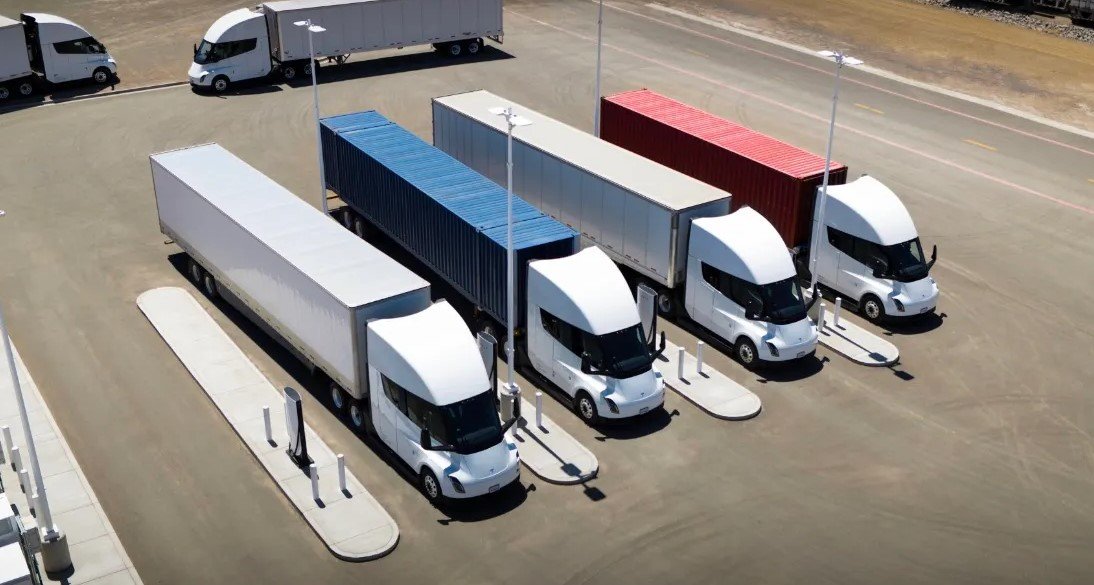
Charging infrastructure is developing in parallel with vehicle deployment. Tesla has opened its first Megacharger site in Ontario, California, a major logistics hub connecting ports to inland distribution centers.
The company plans to build out dozens of Megacharger locations across the US, with additional sites expected to come online through 2026.
This network will be essential for scaling electric trucking beyond localized routes.
Production and Market Outlook
The timing of these pilots aligns with Tesla ramping production of the Semi at its facility near Gigafactory Nevada. The truck is offered in two versions: a 325-mile standard range and a 500-mile long-range model, with pricing starting around $290,000.
Industry estimates suggest Tesla could deliver several thousand units in 2026, with longer-term production targets significantly higher.
Tesla also claims the Semi’s battery is designed to last up to one million miles, a figure that—if validated—could influence total cost of ownership for fleet operators.
Why It Matters
Electric trucks have long faced questions around range, charging, and real-world performance. Pilot programs like MDB’s provide practical data that can help answer those questions, particularly in high-demand environments like port logistics.
Drayage operations, with their predictable routes and centralized infrastructure, are emerging as an early proving ground for this transition.
Takeaway
MDB Transportation’s Tesla Semi pilot highlights how electric trucks are beginning to move from controlled testing into everyday freight operations. As infrastructure and production scale up, port drayage could play a key role in the broader adoption of electric heavy-duty vehicles.