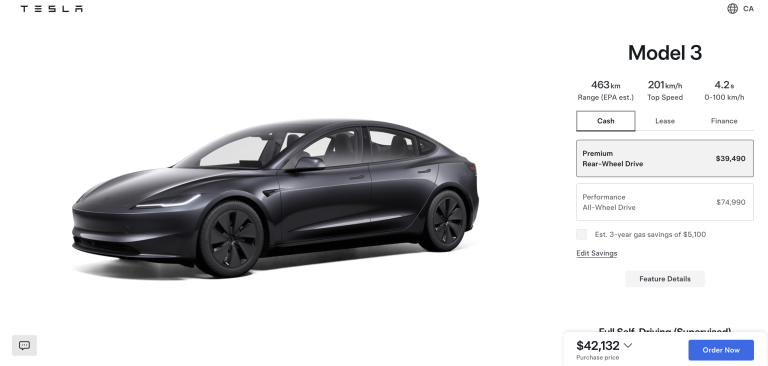
Tesla has introduced a new Model 3 Premium RWD trim in Canada starting at $39,490 CAD, marking the lowest price ever for the sedan in the country. At roughly $29,000 USD, it significantly undercuts both its U.S. equivalent and most competing EVs in Canada.
The catch—and the opportunity—comes down to supply chains.
Tesla is sourcing these vehicles from its Shanghai factory rather than Fremont, California, taking advantage of a revised trade agreement that reduced Canada’s tariff on Chinese-made EVs from 100% to 6.1% under a capped import quota. It’s the first time Tesla has reintroduced China-built vehicles into Canada since tariffs reshaped the market in 2024.
That policy shift is now directly visible in pricing.
The new Model 3 Premium RWD delivers 463 km of range and a 0–100 km/h time of 4.2 seconds—figures that put it squarely in line with mainstream EV expectations. For most buyers, that combination of range and performance is more than sufficient for daily driving.
And at this price, it becomes hard to ignore.
By comparison, the Model 3 Performance trim starts at $74,990 CAD, even after a recent price cut. It offers slightly more range (478 km), faster acceleration (3.1 seconds to 100 km/h), and all-wheel drive—but at a $35,500 premium. That’s nearly double the price for gains that, while measurable, may not matter for typical commuting.
In practical terms, Tesla has created a clear value gap within its own lineup.
The Premium RWD is now about 31% cheaper in Canada than the equivalent model in the U.S., largely due to lower production costs in Shanghai and favorable tariff treatment. Meanwhile, the Performance variant appears to remain U.S.-sourced, with pricing that aligns closely across both markets once exchange rates are considered.
There are trade-offs.
Because the Shanghai-built Model 3 doesn’t qualify for Canada’s federal EV rebate program, buyers miss out on a $5,000 incentive. Competing models like the Hyundai Ioniq 5 and Chevrolet Equinox EV do qualify, narrowing the effective price advantage in some cases.

Still, Tesla’s pricing remains aggressive even without subsidies.
The broader implication is that Tesla is using global manufacturing flexibility to navigate trade barriers and maintain competitiveness—something legacy automakers have struggled to match. But that advantage may not last long. BYD is preparing to enter the Canadian market with local retail expansion, and the import quota for Chinese-built EVs is expected to increase through the decade.
In other words, Tesla may have moved first—but it won’t be alone for long.
Conclusion:
Tesla’s new low-cost Model 3 in Canada is less about a single product and more about strategy. By leveraging Chinese production and shifting trade policy, the company has reset pricing expectations in the market. The real test will be how long it can maintain that edge as competitors—and regulators—catch up.