
BYD has become the best-selling EV brand in the UK so far in 2026, surpassing rivals including Tesla, Volkswagen, and Kia. The shift marks another sign that Chinese EV makers are gaining traction well beyond their home market—and doing so faster than many legacy brands expected.
According to the latest UK registration data, BYD sold 12,754 electric vehicles through April, giving it more than 7% of the country’s EV market. That’s a notable achievement for a company that only entered several major European markets a few years ago.
The timing matters.
While many automakers are seeing slower EV growth due to pricing pressure and weaker consumer demand, BYD continues to expand aggressively overseas. Even though its overall global sales declined year over year in April, the company’s international business reached a record high, with exports rising 70% compared to last year.
That overseas momentum is becoming central to BYD’s strategy.
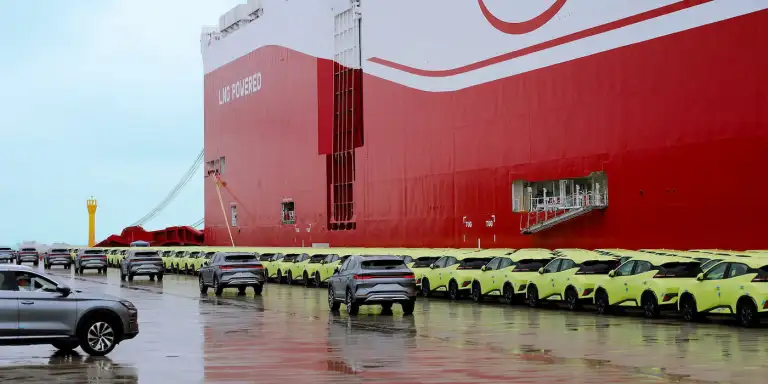
The company sold more than 135,000 vehicles outside China in April alone, fueled by expansion in markets such as the UK, Australia, and Brazil. In several of those regions, BYD is no longer competing as a niche budget brand—it’s becoming a mainstream EV player.
Part of that success comes down to positioning.
BYD’s lineup covers multiple price points and vehicle types, from compact hatchbacks like the BYD Dolphin to larger SUVs such as the BYD Sealion 7. Compared to competitors that often focus on premium pricing, BYD combines relatively affordable vehicles with features typically associated with more expensive EVs.
That formula appears to be resonating with buyers facing high fuel costs and economic uncertainty.
In Australia, the Sealion 7 became the country’s best-selling EV in April, outperforming models like the Tesla Model Y. In Brazil, BYD achieved an even more symbolic milestone by becoming the country’s top-selling automotive brand overall, edging past long-established players like Volkswagen.
The speed of that rise is significant.
Volkswagen has manufactured vehicles in Brazil for decades, while BYD only entered the passenger vehicle market there in 2021. That contrast highlights how quickly the EV transition can reshape competitive dynamics, especially in emerging markets where brand loyalty is still evolving.
Still, there are challenges ahead.
BYD’s rapid expansion depends heavily on maintaining low production costs and scaling international manufacturing. Trade tensions, tariffs, and increasing scrutiny of Chinese-made EVs in Europe and North America could complicate that strategy. At the same time, legacy automakers are beginning to respond with lower-cost EV platforms and more aggressive pricing of their own.
But right now, BYD has momentum.
The company is investing heavily in overseas production and new technologies, including ultra-fast charging systems designed to reduce charging times to just a few minutes. More importantly, it’s proving that Chinese EV brands can compete globally not only on price, but also on technology, design, and scale.
Conclusion:
BYD’s rise in the UK and other overseas markets reflects a broader shift in the global auto industry. Chinese automakers are no longer simply exporting low-cost vehicles—they are becoming serious competitors to established global brands. If BYD can sustain its pricing advantage while continuing to scale internationally, it could reshape the EV market far beyond China.