Lexus has spent years building a reputation around reliability, comfort, and quiet luxury. But when it came to software, especially in electric vehicles, the brand often felt several steps behind competitors like Tesla, Hyundai Motor Company, and even newer Chinese EV makers.
The new 2026 Lexus ES suggests that may finally be changing.
Lexus announced that the all-electric ES will become the first model in its lineup to feature Toyota’s new Arene software platform, a major shift toward software-defined vehicles. More importantly for everyday drivers, the sedan will also introduce built-in EV route planning — a feature Tesla owners have taken for granted for years.
That may sound minor, but in practice, it fundamentally changes how an EV feels to live with.
If you have ever driven long distances in a Tesla, you already understand why route planning matters. You simply enter a destination, and the car automatically calculates where to stop, how long to charge, and which chargers are available along the route. It removes much of the anxiety and guesswork traditionally associated with EV road trips.
Now Lexus is finally bringing a similar experience to its own vehicles.
The 2026 ES debuts a redesigned Lexus Interface infotainment system powered by Automotive Grade Linux and Toyota’s Arene platform, which was developed by Woven by Toyota. In simple terms, Arene acts as the software foundation for future Toyota and Lexus vehicles, allowing the company to deliver faster updates, smarter features, and a more modern user experience over time.

Think of it as Toyota’s attempt to move from “cars with software” toward “software-driven cars.”
That distinction matters because modern EV competition increasingly revolves around digital experience as much as hardware. Consumers now expect their vehicles to behave more like smartphones: responsive interfaces, seamless updates, connected apps, and intelligent navigation systems.
Until now, Toyota and Lexus have struggled in that area.
The new ES appears designed to close that gap. Its updated interface includes a customizable home screen, improved voice assistant, expanded navigation displays, and integrated EV charging management through the Lexus app. Drivers can monitor charging remotely, plan routes around charger availability, and view detailed charging station information directly from the car’s navigation system.
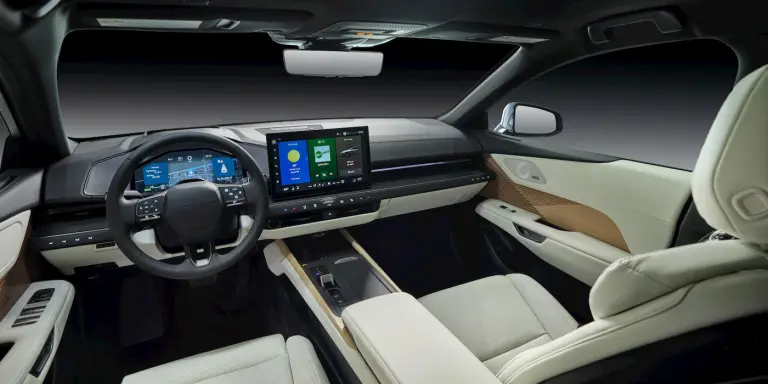
The EV Routing feature is especially significant.
The system can recommend charging stops based on the vehicle’s battery level and destination while displaying practical details such as charger type, station hours, and the number of available chargers. That kind of integration dramatically reduces friction during road trips, particularly for drivers transitioning from gasoline vehicles.
It also reflects an important reality about EV adoption: convenience often matters more than raw range numbers.
The 2026 ES itself comes in two electric variants. The front-wheel-drive ES 350e offers up to 307 miles of EPA-estimated range and starts at around $49,500 including destination fees. The all-wheel-drive ES 500e adds more performance but sacrifices some efficiency for extra traction and power.
From a hardware perspective, the ES remains more conservative than many rivals.
Its estimated charging time — roughly 30 minutes from 10% to 80% — is competitive but not class-leading. Vehicles from Hyundai Motor Company and Kia Corporation built on 800-volt architectures can charge noticeably faster under ideal conditions.
Still, Lexus is focusing less on headline specs and more on overall ownership experience.
The inclusion of a built-in NACS charging port is another important step. That gives the ES direct access to Tesla’s Supercharger network, which remains the most reliable and extensive fast-charging infrastructure in North America. For many buyers, that alone could significantly improve confidence in switching to an EV.
There are, however, some caveats.
Lexus requires an active Drive Connect subscription or trial to fully use the EV Routing and EV Range Map features. That may frustrate some customers, especially as automakers increasingly place core software functionality behind recurring subscription models.
The strategy reflects a broader industry trend, but it also risks creating tension with luxury buyers who already expect premium features at these price points.
At the same time, Toyota’s broader EV strategy appears to be gaining traction. After updates to the 2026 Toyota bZ improved range, charging performance, and usability, the electric SUV became one of the top-selling EVs in the US during the first quarter.
That momentum suggests Toyota may finally be overcoming one of its biggest weaknesses in the EV era: software execution.
The 2026 Lexus ES is not the most radical EV on the market. It will not outperform a Tesla in acceleration, nor will it necessarily beat Hyundai or Lucid on charging technology. But it may represent something more important for Lexus: the point where the company finally starts treating software as a core product rather than a secondary feature.
And in today’s EV market, that shift could matter more than horsepower or battery size.