
When BYD says solid-state batteries have reached a “critical stage,” it sounds like the kind of milestone the EV industry has been waiting for. But looking deeper, this isn’t a finish line moment. It’s more of a transition point — where promising lab results begin to collide with the realities of scaling production.
At a recent industry seminar, BYD’s chief scientist Lian Yubo made it clear that while progress has been meaningful, key technical barriers remain. The two most important are ion stability and lithium dendrite formation. These are not minor engineering issues. Dendrites, for example, are microscopic structures that can grow inside a battery during repeated charging cycles. If they pierce internal layers, they can cause short circuits, directly impacting safety and lifespan. Managing this consistently across millions of cells is one of the hardest challenges in battery engineering today.
In theory, solid-state batteries offer clear advantages. By replacing liquid electrolytes with solid materials, they promise higher energy density, improved safety, and potentially faster charging. That’s why they are often described as the “next generation” of EV batteries. However, what works in controlled environments doesn’t always translate into mass production. Maintaining stable ion flow through solid materials, especially under varying temperatures and usage patterns, remains a complex problem that has not yet been fully solved.
What stands out in BYD’s approach is its realism. Instead of positioning solid-state as a near-term replacement, the company continues to invest heavily in existing lithium-ion technologies, particularly lithium iron phosphate (LFP). This is where BYD already leads, and the results are hard to ignore. Its latest Blade Battery 2.0, for example, can deliver over 1,000 km of range under China’s CLTC testing cycle and supports ultra-fast charging under ideal conditions. In real-world terms, that level of performance already satisfies most daily driving needs, which reduces the urgency for an immediate transition to solid-state.
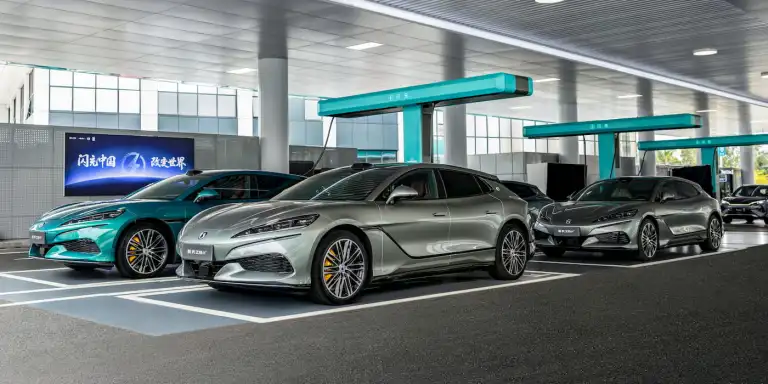
This dual strategy also reflects a broader industry trend. Companies like Toyota and QuantumScape are also working toward solid-state commercialization, but on similar timelines. BYD expects limited production around 2027, with mass production closer to 2030. That consistency across major players suggests the technology is progressing steadily, but not rapidly.
From a technical comparison standpoint, today’s lithium-ion batteries still hold strong advantages in scalability, cost, and proven reliability. Solid-state batteries, on the other hand, offer higher theoretical performance but come with manufacturing complexity and higher initial costs. In practice, this means the two technologies are likely to coexist for years rather than compete directly. Solid-state batteries will likely appear first in premium vehicles, where higher costs are easier to justify, before gradually moving into the mass market.
From a personal perspective, what makes BYD’s position credible is its balanced view. Instead of overpromising, the company acknowledges both the potential and the limitations of solid-state technology. That’s important, because the EV industry has a history of announcing “breakthroughs” that take far longer to materialize than expected. This time, the messaging feels more grounded in engineering reality.
The bigger picture here is that battery innovation is not a single leap forward but a series of incremental improvements. While solid-state batteries will eventually play a major role, the next few years of progress in electric vehicles will still be driven by refining existing lithium-ion technologies — improving energy density, charging speed, and durability step by step.
The takeaway is straightforward. Solid-state batteries are getting closer, but they are not an immediate solution. For now, the real momentum in the EV market continues to come from technologies that are already proven and scalable, and that is where companies like BYD currently have their strongest advantage.


